

On This Page
History
Thanksgiving at the Del
On Thanksgiving Day, 1892, a young woman walked into the Hotel del Coronado, the four-year-old resort across the bay from San Diego, carrying nothing but a small handbag. She didn’t sign the register herself. The young man at the front desk wrote it for her, at her request: “Mrs. Lottie A. Bernard, Detroit.” When the clerk, A. D. Gomer, came to the office that evening, the young man pointed her out to him. “Rather a peculiar person came in this afternoon,” he said.
The next morning, she asked Gomer how she could get her baggage. Her brother had the checks for it, she said. He had been called away from Orange, where they had been together, to Los Angeles or San Francisco, she didn’t know which, and she had come on alone. He was a doctor, Doctor Anderson, and he would be along that afternoon. Every day after that, she asked at the desk whether her brother had arrived.
She kept to her room. She told the housekeeper she had cancer of the stomach, The San Diego Union reported, and the bellboy, Harry West, that she had “the neuralgia very bad.” When the staff urged her to see the house physician, she said there was no need, because her brother was a physician. On Monday morning, when a bellboy told her once more that her brother hadn’t come, she said, “Oh, no one comes to me any more!”
Gomer went up to see her that day. “It was a very gloomy, dreary sort of a day,” he told the coroner later, and she was lying in bed in a room with no fire. She said she was comfortable.
The Gun
That afternoon, she crossed the bay to San Diego. Three men there told the inquest about her. At a ship chandlery on Fifth Street, she asked a clerk, Frank Heath, whether he kept revolver cartridges. “She came in and spoke to me three or four times before I could understand her, she spoke so low,” he said. “She seemed a little nervous.” Heath didn’t sell them, and he sent her to M. Chick, a gun dealer.
A customer named W. P. Walters was in Chick’s store when a woman in black walked past him to the case where the pistols were. She said she didn’t want a very high-priced one, bought a revolver and cartridges, and asked Chick to show her how to load it. Then she took hold of the pistol herself and pulled. “Isn’t this hard to pull?” she asked. It was a Christmas present for a friend, she told Chick. Walters never saw her face. Chick, shown the body, said it looked a great deal like the woman, “but I would not swear it was the same woman.”
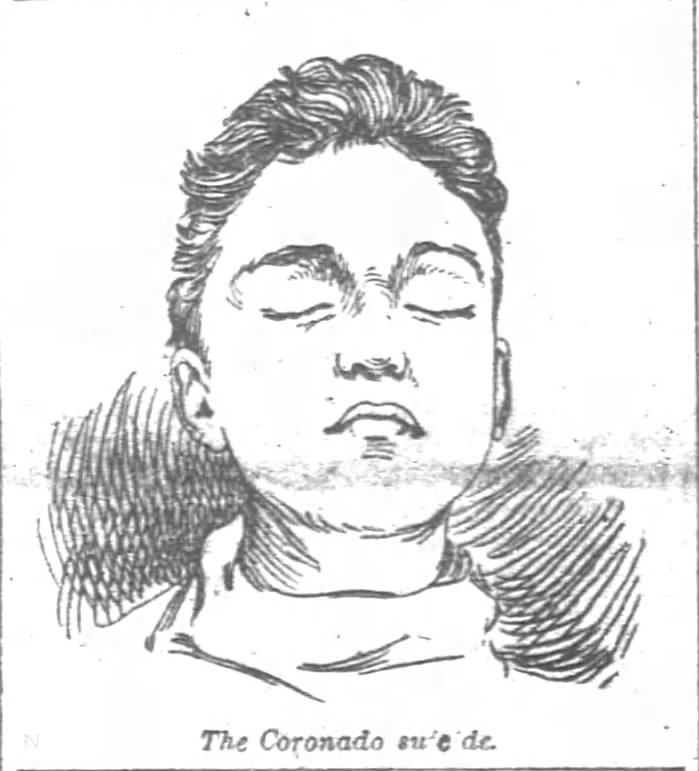
That night, a storm was sweeping the coast. Between 9 and 10 o’clock, the paper said, she stepped out onto the veranda facing the ocean, “quietly and elegantly dressed in black,” with a lace shawl over her head. Her bed was never touched. Nobody heard a shot. David Cone, the hotel’s electrician, started trimming the electric lights at seven every morning. At half past seven the next day, he was about to climb a pole at the hotel’s ocean corner when he saw her lying on the stone steps to the beach, “with its feet towards the ocean.” A revolver lay by her right hand. She had been shot in the right temple, and the rain had washed away the blood.
The Inquest
The next day, a coroner’s jury of nine men heard from the hotel staff, the gun dealer, and the doctor. Deputy Coroner H. J. Stetson told them what she had left. There was $16.50 in the purse she had with her. In her room’s grate, “quite a package of papers had been burned.” And there were papers with a name written on them over and over. “Lottie Anderson Bernard.” “Mrs. Lottie Bernard.” “Lottie Anderson Bernard, Detroit.” The name “Frank” was written four times. On one scrap, she had written: “I merely heard of that man, I do not know him.” No report we’ve found says who Frank was.
The jury returned a verdict of suicide, the San Francisco Chronicle reported. When it did, nobody had claimed her body.
Five Names
Then the papers went looking for her name. They called her the “beautiful stranger,” the hotel says. On December 4, the Los Angeles Herald announced that she was Lizzie Wyllie, a young woman who had vanished from her home in Detroit six weeks before. A reporter was in the Wyllie house when the description of the dead woman arrived, the Union reported. Lizzie’s mother read as far as the two moles on the cheek, and dropped the telegram. “It’s my Lizzie, it’s my Lizzie,” she sobbed.
She wasn’t. On December 6, a dispatch from Detroit reported that Lizzie Wyllie was alive, in Toronto. By then, a small town in the southwest corner of Iowa had come into the story. The woman at the Del had telegraphed a man in Hamburg, G. L. Allen, for money. He had sent her $25 “simply out of charity,” the Hamburg dispatch said, and people there believed she was the wife of L. A. Bernard, “a professional gambler.”
On December 8, the Los Angeles Times had another name. Mrs. Katie Logan, a domestic for a family named Grant on South Hill Street in Los Angeles, had left on November 23, promising “that she would be home next day in time to cook the Thanksgiving dinner.” She had told people there that her name was Lizzie, “but that she liked the name of Kittie better.” The day before she left, she had been “anxious to get some papers signed,” and nobody knew why.
The police opened the trunk she had left at the Grants’. Every name, date, and address in it had been destroyed, except those on a marriage certificate. Katie K. Farmer had married Thomas E. Morgan at Hamburg, Iowa, on December 30, 1885. In a paper in the trunk was a lock of blond hair, labeled “Elizabeth A. Morgan’s hair.” The police traced her route west from Chicago through Omaha, Cheyenne, Ogden, and Sacramento. She would say little about her past to the Grants’ other servants. “She told them that she married a gambler and that she was not happy with him,” the Times wrote.
The Herald still wasn’t sure. The photograph of Mrs. Morgan in her trunk didn’t look like the woman at the Del, it said, under the headline “Not the Coronado Woman.” But on December 9, the Morning Call of San Francisco reported her “positively identified” as Mrs. Kate Morgan. Two weeks after her death, she was buried under that name at Mount Hope Cemetery in San Diego. Her grandfather, J. W. Chandler of Riverton, Iowa, paid for the funeral. No one followed the hearse, the Sacramento Record-Union reported.
Hauntings & Lore
Kate Morgan is the Del’s most famous ghost, and the hotel tells her story every night on its own ghost tour. It sells its own book about her, too: Beautiful Stranger, written by its historian at the time, Christine Donovan, and published in 2002.
Her Room
The hotel says she turns up all over the grounds, but most of what guests report happens in her old third-floor room: flickering lights, a television that turns itself on and off, breezes from nowhere, doors that open and close. Donovan kept files on what guests told her. One business executive wrote that he woke at 2 a.m. to “exceedingly cold temperatures and the ceiling fan working at high speed.” Later he woke again “to find that all of the bed pillows had been stacked pyramid style on top of my computer.”
Gina Petrone, the hotel’s historian by 2021, told San Diego Magazine that year that the lights and the television are not unexpected in a hotel that old. What’s harder to explain, she said, are the guests who feel fingertips brushing their cheek while they sleep, and Kate’s initials, KM or LB, appearing on the ceiling. Staff have had to paint over them numerous times. Historic Hotels of America, a program of the National Trust for Historic Preservation, calls her room “the most requested guestroom at the resort.” It’s Room 3327.
Which Room Is Hers?
Room 3327 hasn’t always been the answer. In 1983, an article by Richard Carrico in San Diego Home and Garden magazine said her room, 302, had been renumbered after a renovation and was now 3502. In August 1989, a San Francisco defense lawyer named Alan May spent a night there, hoping to see her. When she didn’t come, he decided he was in the wrong room, by the account of Terry Girardot, a Texas author whose own book on Kate came out in 2001. May found the original register, which put Kate in 302, compared the original floor plans with the 1930 revision, and asked to be moved. He said he saw her ghost that night, in Room 3312.
San Diego Magazine, in 2015, put her in “room 3327 (then 302).” Girardot calls 3312 the room she haunts. None of the sources we’ve read prints the floor plan that would settle it. Three numbers for one room, and the one guests ask for is 3327.
Was She Murdered?
May went on to argue that Kate’s death may have involved foul play. In 1990, he published The Legend of Kate Morgan. He also declared that she was his great-great-grandmother. The Del rejects his story, and Girardot says his book “seems to have become the cornerstone for all contemporary versions” of the ghost story. “Much of it is wrong,” Girardot adds. May, the book says, was “adept at suggesting scenarios to introduce reasonable doubt.”
His best-known point came from the inquest. Dr. B. F. Mertzman, who examined her, was asked the size of the bullet. He said, “From the looks of it, I should say about 38 or 40.” The gun by her hand was a 44-caliber American bulldog. But in the transcript Girardot publishes, the doctor was then handed the pistol and asked whether the bullet was about that size. “Yes, sir, about the size of that,” he said.
Her Grave at Mount Hope
Kate lay in an unmarked grave at Mount Hope for almost a century. May found it with help from someone at the cemetery. In September 1989, he had a monument put on it. Its words, as Voice of San Diego, a local news site, printed them: “Kate Morgan/Also Known as/Lottie A. Bernard/Died Nov. 29, 1892/At Age 24 Years.”
Twenty-four is the age she gave at the hotel. If the birth year in her Wikipedia biography, around 1864, is right, she was closer to 28. Even her headstone took her at her word.
To stay in Kate Morgan’s room, ask for Room 3327 when you book the Hotel del Coronado‘s Victorian building.
Been here?
Tell us what happened.
Related Places
Hotel
Hotel del Coronado
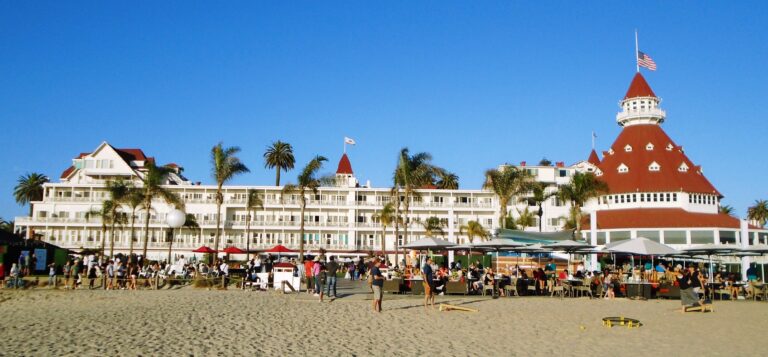
Kate Morgan checked into the Del under a false name on Thanksgiving Day, 1892, and was found shot dead on its steps to the beach five days later. The hotel says she never checked out.
Contributors

Sources (9)

The Ghost of the Hotel Del Coronado: The True Story of Kate Morgan
Terry Girardot, 2001, posted by IAGenWeb (Fremont County, Iowa)
Its transcription of the coroner's inquest of November 30, 1892, and of the San Diego Union, Los Angeles Times and San Francisco Chronicle reports of November 30 to December 9, 1892; its account of Alan May and the room numbers.

From the archives: 1892 death in Coronado
The San Diego Union-Tribune · Merrie Monteagudo, November 26, 2017
Reprints The San Diego Union of November 30, 1892, "By Her Own Hand."

loc.gov
The Library of Congress's newspaper archive: the Los Angeles Herald, December 4 and December 9, 1892; The Morning Call (San Francisco), December 3 and December 9, 1892; the Sacramento Daily Record-Union, December 14, 1892.

The hotel's account of Kate Morgan, its ghost story blog post and its tours page.

"Inside the Icon: Room 3327" (Archana Ram, September 25, 2015) and "I Tried It: Room 3327 at Hotel Del Coronado" (Erica Nichols, October 11, 2021).

Paranormal Activity at the Hotel del Coronado – Have You Seen Kate Morgan?
The Coronado Times · October 16, 2014

At the Hotel Del, a Deadly Obsession
Voice of San Diego · Randy Dotinga, November 2011

The 2023 Top 25 Historic Hotels of America Most Haunted Hotels List
Historic Hotels of America, 2023

Wikipedia