
On This Page
History
Lost Under Hell Street
Paris tells Philibert Aspairt’s story with a candle, a ring of keys, and a cellar full of monks’ liqueur. We’ll get to all of that. The surviving records tell a barer story, and in some ways a stranger one.
It starts underground. Paris was built from the stone under its own feet. By the 1790s, centuries of digging had left old quarry tunnels running under the streets, houses, and gardens south of the River Seine. In the thick of the French Revolution, Philibert went down into them. He did not come back up.
At noon on May 2, 1804, a man’s remains were found in the quarries under the rue d’Enfer. The name translates as Hell Street, and the street has since been renamed.
Nearly everything known for certain about the dead man comes from his death record, drawn up 16 days later. It calls him Philibert Asper. A stone monument put up in the tunnels years later spells the name Aspairt, and that is the spelling that stuck. The record calls him a quarry worker, a loose term at the time for anyone who worked in the tunnels. He was born in a village in central France. He had a home on the rue Saint-Jacques, the next main street east of Hell Street, and a wife named Elisabeth Millard. He had been missing from that home for 10 to 12 years.
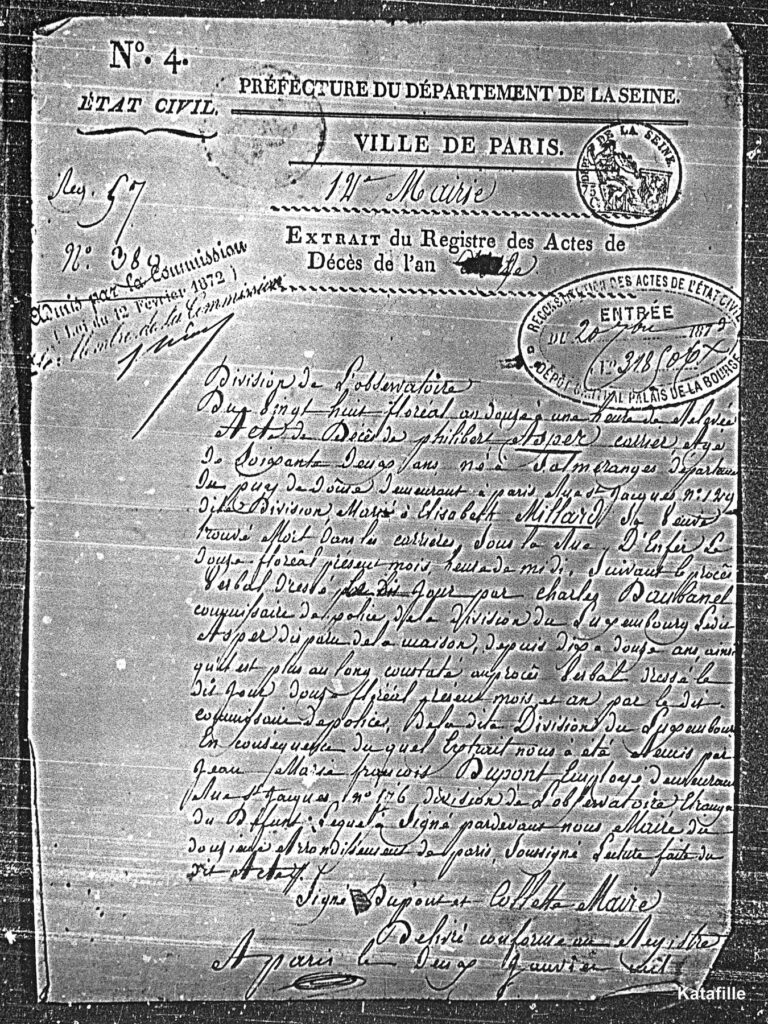
That puts his disappearance between 1792 and 1794. He was about 60 when he vanished, going by his village’s baptism register, and he and Elisabeth had been married some 25 years.
The record leaves out the best parts. It doesn’t say who found him. It doesn’t say how anyone knew that remains a decade old belonged to Philibert. A police commissioner wrote a report on the day of the discovery, and those answers would have been in it. The report is lost.
What was he doing down there? The earliest answer comes from the city’s quarry service, which was founded in 1777 after the ground above the old diggings began to collapse. In 1813, the engineer who ran it, Louis-Étienne Héricart de Thury, wrote that everyone in the service knew the story. Philibert was not one of the service’s own men. He was an outside workman, hired to shore up a house from below, and he strayed from his job and lost his way. His remains turned up years later, Héricart wrote, deep in the quarries under the Luxembourg Garden. The garden lies just west of Hell Street, so his account and the death record point to the same patch of ground.
Héricart was passing on a story he had heard. He took over the service five years after the remains were found, and the year he gives for the disappearance, 1801, doesn’t match the death record. But his is the closest thing to an explanation that survives.
The Stone
Someone gave Philibert a monument. It stands in a tunnel under what is now the rue Henri Barbusse, a stretch of the old Hell Street. It is a plain limestone slab with a peaked top, set in a niche against a wall painted black.
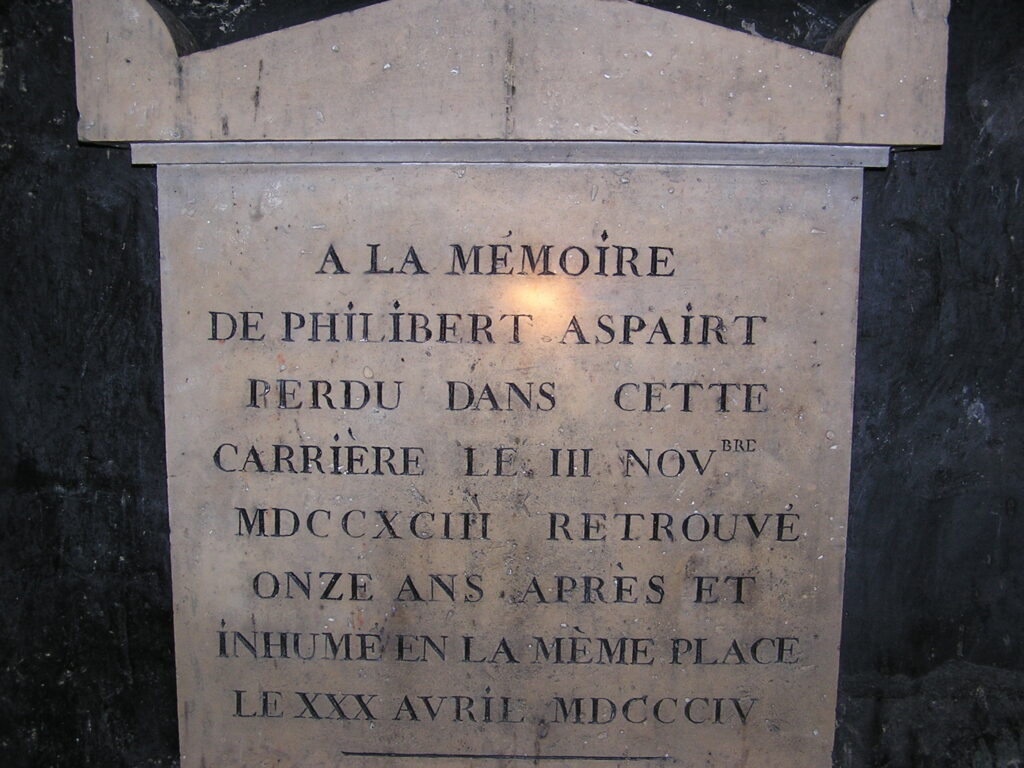
A black line runs along the tunnel ceiling past it. The quarry service painted lines like it to lead anyone who was lost back to the way out. If the line had always been there, a Paris magazine remarked in 1873, there would be no stone.
In English, the inscription reads: “To the memory of Philibert Aspairt, lost in this quarry on November 3, 1793, found eleven years later and buried in the same place on April 30, 1804.”
Almost every line of it raises a question.
Start with November 3. The year fits the death record, but no surviving record gives a day, and nobody knows who supplied one. Then there is the burial. The stone says Philibert was buried on April 30, 1804. The death record says he was found on May 2, two days after the stone has him in the ground.
Nobody knows for certain who ordered the stone, either, or when. The best clue comes from a novelist, Élie Berthet, who saw it in the 1850s. In a footnote to his novel about the tunnels, he wrote that the quarry service had raised it.
The biggest question is the last line. The stone says Philibert was buried in the same place, and nobody can say whether he was. No surviving register records a burial. Yann Bussière, a researcher of underground Paris who published the records on Philibert in 2025, doubts he is there. Elisabeth was still alive when her husband was found, and she lived until 1824. A man with a wife to bury him, Bussière argues, would not have been left in a quarry tunnel, in ground no church had consecrated.
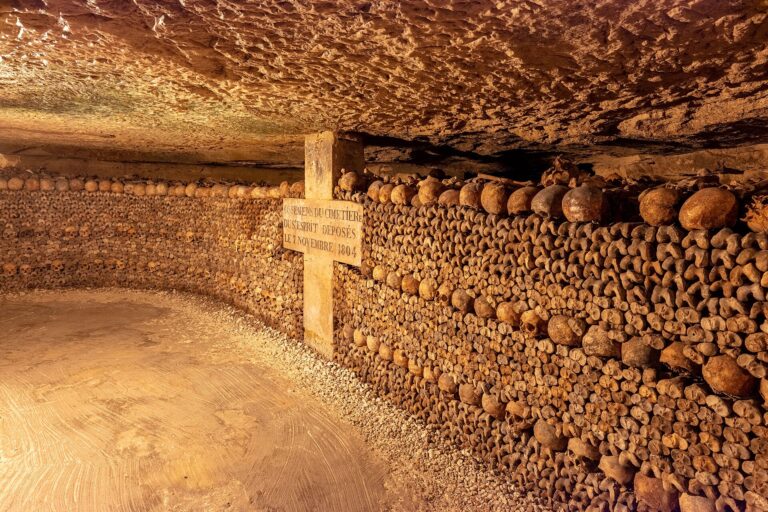
Bussière suspects the remains went to the ossuary instead. That is the section of the tunnels that was consecrated in 1786 to hold the bones from the city’s old cemeteries. Tourists know it as the Catacombs of Paris. Philibert’s stone is not in that section.
Hauntings & Lore
The records leave a missing workman, a lost police report, and a stone that argues with the record. The legend fills in the rest.
The Doorkeeper and the Monks’ Cellar
Here is the story as tour guides and travel writers in Paris tell it.
It is November 1793, in the months of the Revolution known as the Terror. Philibert Aspairt is the doorkeeper of the Val-de-Grâce, a former abbey on the rue Saint-Jacques that has just been turned into a military hospital. He has his eye on a cellar. The Carthusian monks had a monastery by the Luxembourg Garden until the Revolution shut it down, and their cellars are said to still hold wine and the monks’ famous liqueur. Some tellers name it: Chartreuse.

One evening, he takes a single candle and goes down a staircase in the hospital courtyard, into the tunnels. Somewhere in the dark, the candle goes out. Eleven years later, his skeleton is found with the hospital’s keys still on its belt, and he is buried where he lay.
That is how Paris ZigZag, a French travel website, and The Tour Guy, a company that leads tours of the Catacombs, tell it. The company adds a ghost. Its online guide to the legends says that “every November 3rd, Philibert’s ghost haunts the labyrinth of the catacombs.” November 3 is the date carved on his stone.
A Story 200 Years in the Telling
Stories told in the dark tend to grow, and this one has had more than 200 years. We followed it back through French newspapers and books. The quarry service’s version of 1813 had only a workman who took a wrong turn. The rest arrives one piece at a time.
The keys came first. In 1836, the Paris newspaper Figaro told of a locksmith who was locked in the tunnels and found years later as a skeleton, with his keys beside him. Figaro gave him no name.
The hospital came next. In 1847, a writer for a Paris newspaper toured the tunnels. His guides told him about a gardener from the Val-de-Grâce who was lost down there and found with the skeleton of his dog. The dog never appears again. The hospital stayed.
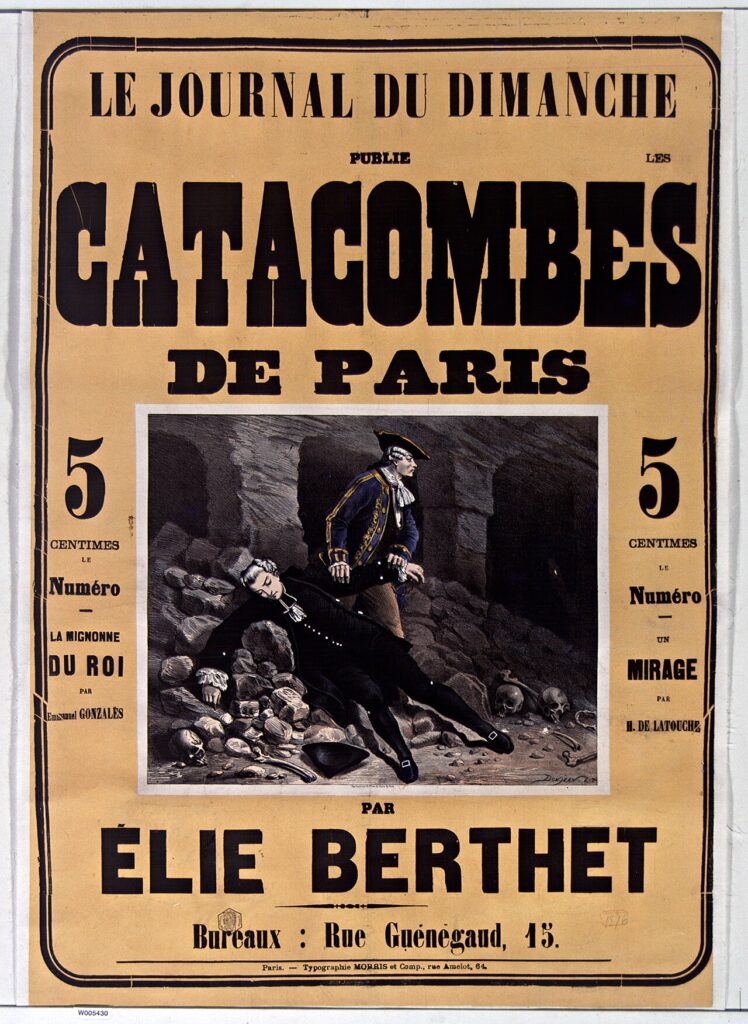
Then Berthet, the novelist who had seen the stone, tied it all to the name carved there. His novel about the tunnels, Les Catacombes de Paris, came out in 1854, and it has a character called Philibert Aspairt. He is the doorkeeper of the Val-de-Grâce, he holds the keys to the hospital’s way into the tunnels, and he gets lost underground while searching for a kidnapped woman. The novel ran as a serial in newspapers around France.
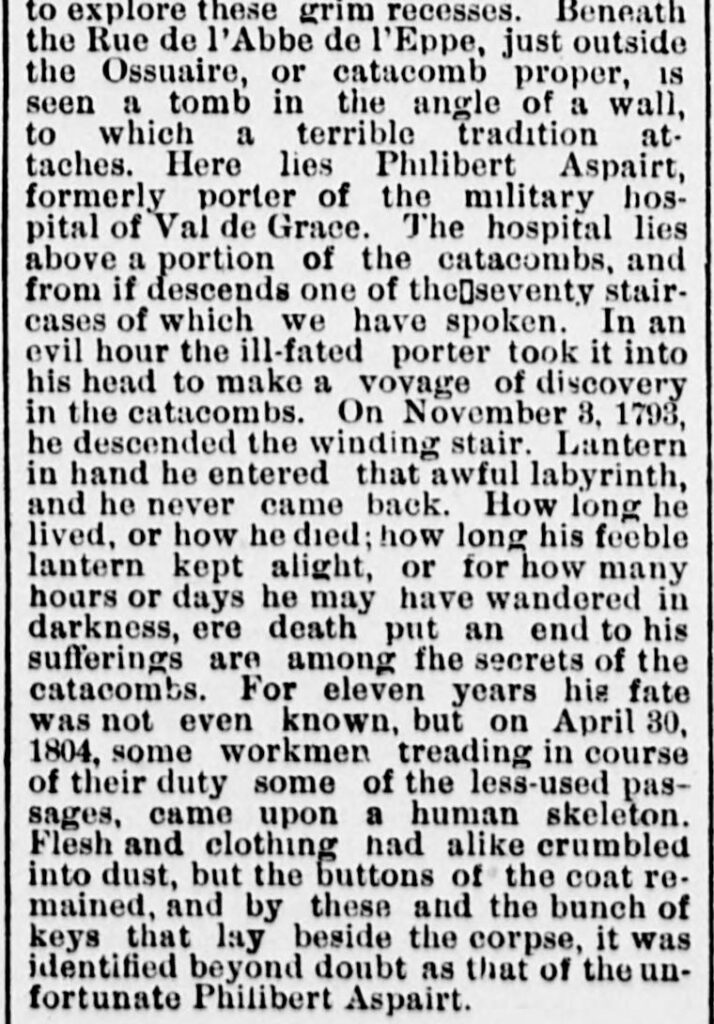
By the 1870s, Paris papers were printing the doorkeeper as history. They said he was identified by his keys and his uniform buttons. By 1887, the story had crossed the Atlantic. “Lantern in hand he entered that awful labyrinth, and he never came back,” the Omaha Daily Bee told readers in Nebraska. In the old tellings, it is always a lantern or a lamp. The single candle is a modern touch.
The monks’ cellar was the last big piece, and it came from Émile Gérards, whose histories of underground Paris are still the tunnel explorers’ main source. In 1908, he offered a motive and hedged it with a “perhaps.” The doorkeeper may have hoped to find wine or liqueurs in the monks’ cellar. Every bottle in the story since comes from that “perhaps.”
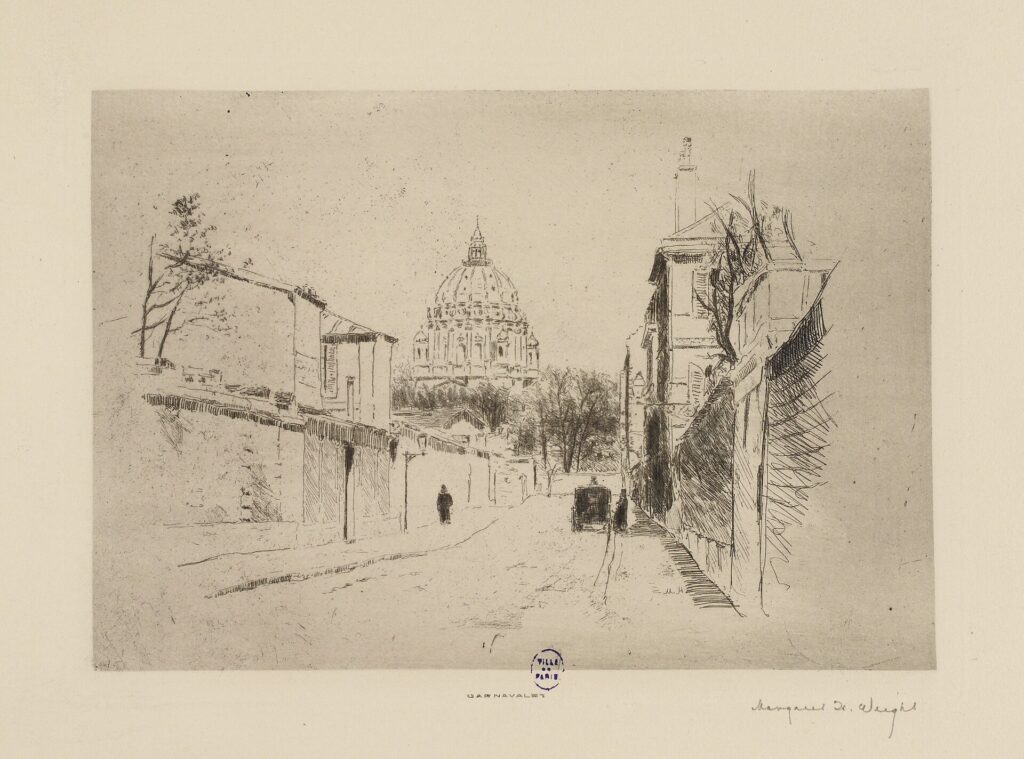
Philibert’s death record calls him a quarry worker, and the doorkeeper first appears in Berthet’s novel. But the legend didn’t come from nowhere. The staircase in the hospital courtyard is real, and it is on the quarry service’s own list of entrances, printed in 1815. The hospital stands on the rue Saint-Jacques, the street where Philibert lived. His stone stands in the tunnels between the hospital and the Luxembourg Garden. A workman from the rue Saint-Jacques went underground in his own neighborhood and never came up. Paris has been filling in the rest ever since.
The Cataphiles’ Patron Saint
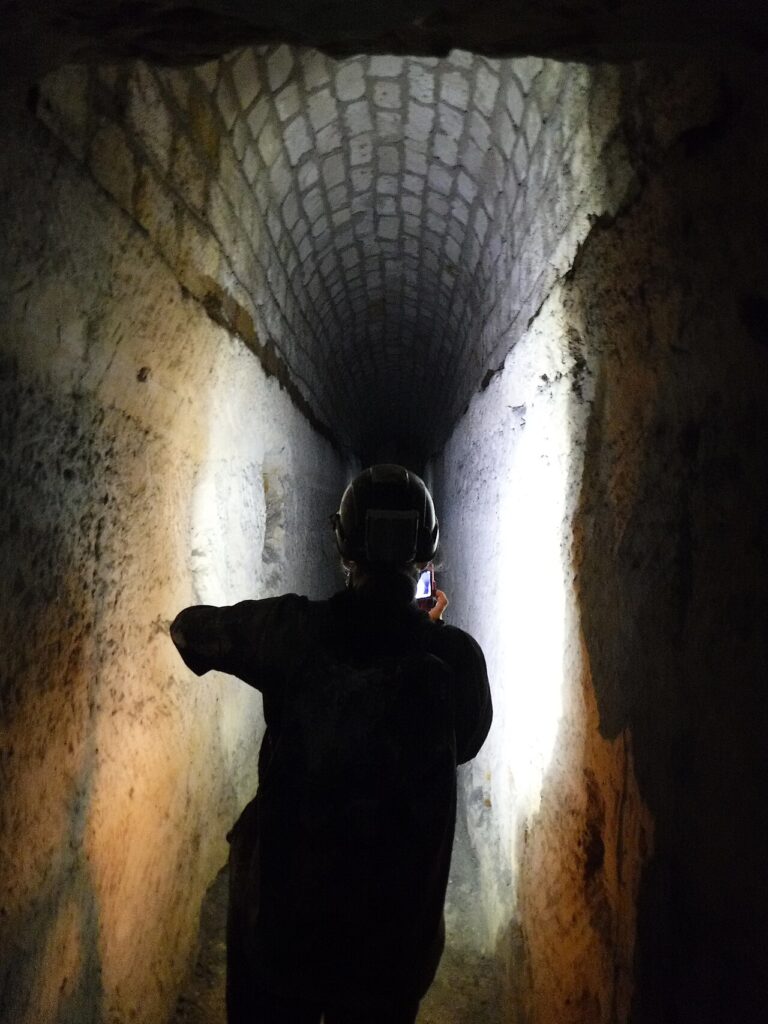
The people who know the tunnels best have made Philibert their own. They are the cataphiles, the explorers who sneak into the closed tunnels, and Paris ZigZag says they count him as their patron saint. Gérards wrote in 1892 that of the people who had died lost in the quarries, Philibert was the only one history remembered. The people who run the same risk remember him too.
The ghost belongs to them as well. The Tour Guy credits the November 3 haunting to folklorists and to the cataphiles themselves. We haven’t found anyone’s account of meeting him down there. Then again, the people who would know aren’t supposed to be there.
In 2023, the writer Ingrid Rojas Contreras took up his story in The New York Times Magazine. “Cataphiles see Aspairt as a protector of the catacombs,” she wrote. She gets lost everywhere, she says, and after a visit to the tourist section of the Catacombs, she worked out that her Paris hotel stood directly above his stone. She adopted him as a saint of her own, for people who lose their way.
Reaching the stone is against the law. The tunnels outside the tourist section have been closed to the public since 1955, and the fine is 135 euros. People go anyway. The French Interior Ministry counted 342 fines in 2024.
For all those visitors, the stone’s biggest claim has never been tested. It says Philibert is buried in the same place. Is he? No dig has ever been reported. Bussière, the researcher who doubts Philibert is there, explains why. A proper excavation would need the archaeological authorities, and digging could bring down the monument and disturb the dead man, if he is there. He warns the cataphiles not to try it on their own. Radar, he suggests, could show whether there is a grave under the stone without moving a thing.
Until someone tries it, the stone has the last word, and the cataphiles have their saint.
Philibert’s stone is off limits. The Catacombs of Paris are open, and guided tours take visitors into locked rooms along the official visitor route that ordinary ticket holders don’t see.
Been here?
Tell us what happened.
Related Places
Underground
Catacombs of Paris
Paris moved the bones of several million of its dead into old quarries beneath its streets and stacked them into walls. Legend has it that one man went into the tunnels with a video camera, and only the camera came back.
Dig Deeper
Investigations

Books
-

The Catacombs of Paris
The History of the City’s Underground Ossuaries and Burial Network. read more
Contributors

Sources (12) including 4 records of the time · 4 records of the time
Records of the Time 4
Newspapers, records, surveys, and photographs made when it happened.
-

The death record of Philibert Asper, 28 floréal an XII (May 18, 1804), in the reconstituted civil records (5Mi1 1155), read on the page image.
-

The French national library's digital archive: Figaro, June 27, 1836; Élie Berthet, Les Catacombes de Paris (1854 to 1856); Journal pour tous, February 23, 1873; La République française, December 10, 1874.
-

Description des catacombes de Paris
Louis-Étienne Héricart de Thury, 1815, on the Internet Archive
-

Omaha Daily Bee, March 6, 1887, page 11
Chronicling America, Library of Congress
Histories and References 5
What historians, museums, historical societies, and official bodies have written since.
-

unterhist-blog · Yann Bussière, February 12, 2025
His transcriptions of the baptism, the marriage, the 1804 death record, Héricart de Thury's 1813 report, and La Démocratie pacifique of August 22, 1847; the monument and the pillar beside it; Elisabeth Millard's last years; and why no one has dug under the stone.
-
Émile Gérards, Les Catacombes de Paris (1892) and Paris souterrain (1908).
-

Catacombes de Paris, the official site
-

Written question no. 03710: the dangers of illegal exploration of the Paris catacombs
French Senate · answer of the Interior Ministry, June 5, 2025
-

Musée du Service de santé des armées
French Ministry of the Armed Forces
News, Lore, and Guides 3
Later reporting, ghost lore, and the places and guides that tell the stories.
-

The New York Times Magazine · Ingrid Rojas Contreras, March 26, 2023
-

La troublante histoire du gardien disparu des Catacombes de Paris
Paris ZigZag, updated September 8, 2022
-

Chilling Legends & Myths About the Paris Catacombs
The Tour Guy