
On This Page
History
From Plantation to Cemetery
Bonaventure was a plantation before it was a cemetery, and its name means “good fortune.” It was settled between 1760 and 1765 by Colonel John Mullryne and his son-in-law, Josiah Tattnall Sr. Tattnall sided with the British in the Revolution, and the land was confiscated after the war. His son, Josiah Tattnall Jr., bought it back in 1785. The family kept it until March 10, 1846, when they sold it to Peter Wiltberger, the founder of the Pulaski House, a Savannah hotel.
That same year, Wiltberger set aside part of the land as a private cemetery, first called Evergreen. His son, William, formed the Evergreen Cemetery Company in 1868. In 1907, the City of Savannah bought it, opened it to the public, and renamed it Bonaventure.
The Sculptor and the Naturalist
More than 70 of Bonaventure’s monuments are the work of the sculptor John Walz. For all the stones he carved, his own grave was marked only by a simple wooden sign until 2015, when the Bonaventure Historical Society gave it a white granite monument.
In October 1867, the naturalist John Muir walked out to Bonaventure. He was waiting for money from home, and he slept among the graves for about five nights. He titled that chapter of his book about the walk “Camping among the Tombs.” The old plantation mansion, he noted, was “in ruins.”
The cemetery holds the lyricist Johnny Mercer, a co-founder of Capitol Records, and Noble W. Jones, a Whig leader of the Revolutionary era. More than 500 Confederate soldiers are buried here too, and the cemetery has the nation’s second-largest section for those killed in the Spanish-American War.
Hauntings & Lore
The City of Savannah bars any tour marketed as haunted from its cemeteries, and nobody may be on these grounds between eight at night and six in the morning. The stories are told from outside the gates.
Little Gracie
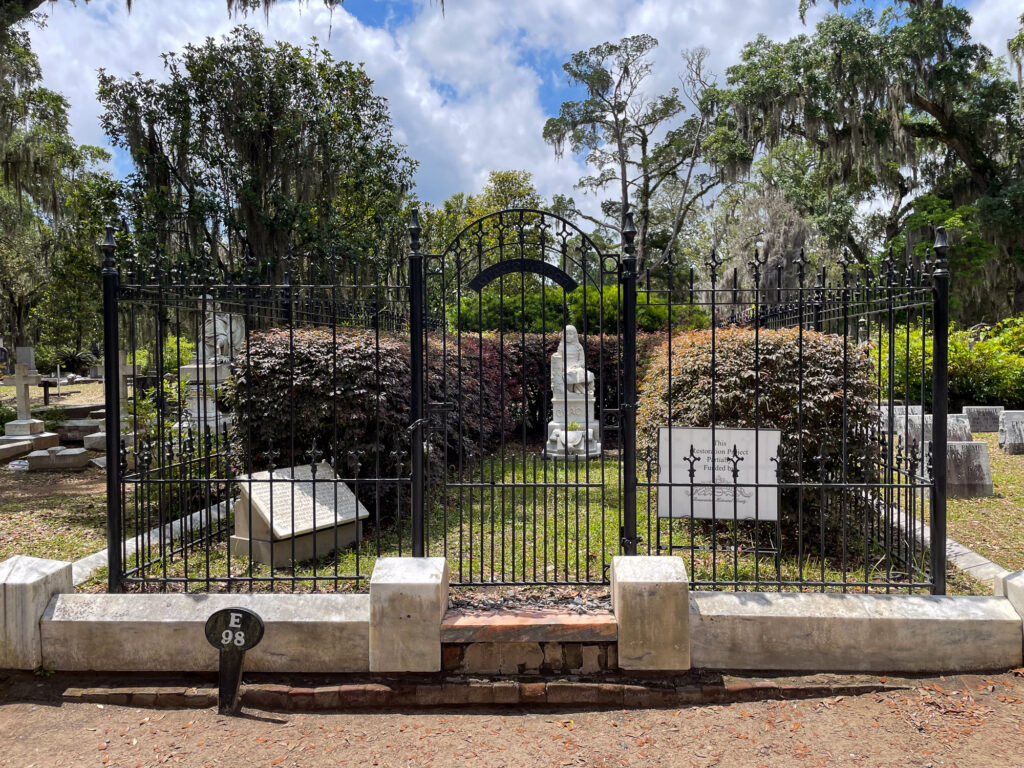
Grace Watson, known today as Gracie, was the only child of W. J. Watson. The family lived at the Pulaski House, the hotel on Johnson Square that he ran. An advertisement that April lists the hotel’s proprietors as Watson and Powers. Gracie was “a general favorite among the guests,” the Morning News wrote. At two o’clock on the morning of April 22, 1889, after three weeks of illness, she died there of blood poisoning brought on by pneumonia. She was six. Her funeral was held that same morning in the hotel’s parlors, and she was buried here, in Section E.
The next year, John Walz carved her likeness in marble from a photograph. The statue stands over her grave, behind a wrought-iron fence put up in the 1990s to protect it.
The Easter Story
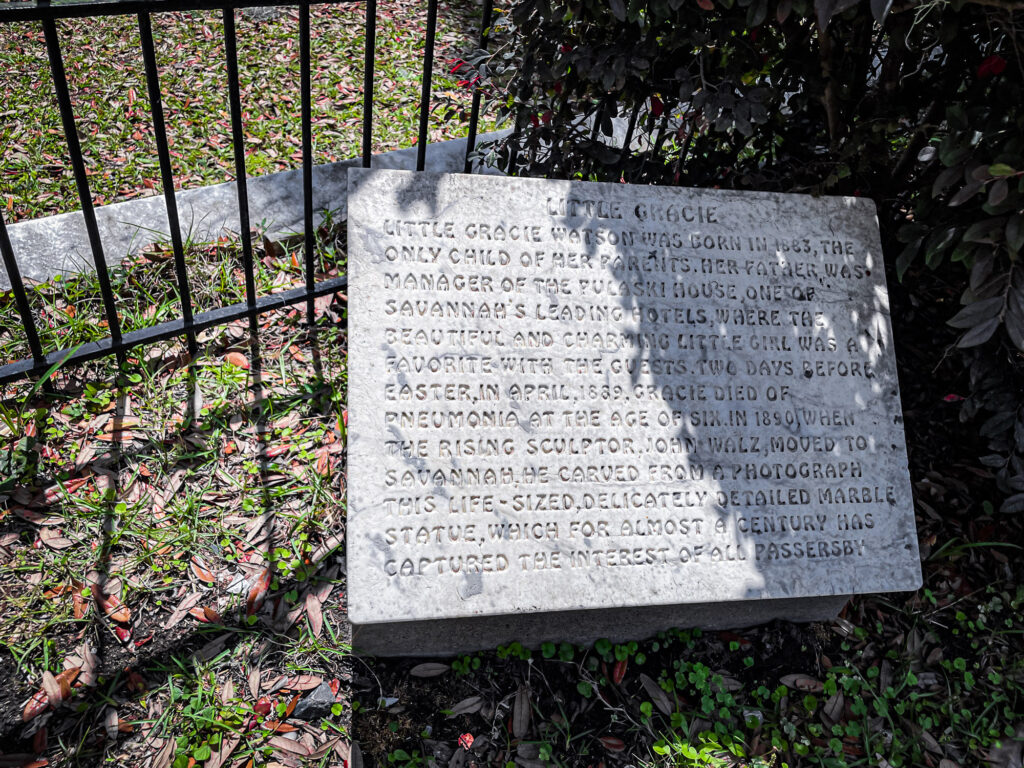
The marker at her grave tells it differently. It says she died two days before Easter, and the Historical Society’s guides tell it that way. One version has her dying suddenly, just after she was photographed in her new Easter clothes. The Morning News of April 23, 1889, has it the other way around. Easter fell on April 21 that year, and Gracie died the next morning, after an illness of three weeks.
The Gifts
Savannah still brings her presents. The Historical Society says toys and gifts are left at the gate to her plot, most of all at Christmas. One visitor remembered children buying presents and riding their bicycles the three miles out to Bonaventure to leave them.
Tears and a Girl in White
The stories grow out of the gifts. Ghosts & Gravestones, a Savannah trolley tour company, tells that if her toys are taken, the statue cries tears of blood. Gracie, it says, didn’t stay in Bonaventure. People report a little girl in a white dress playing in Johnson Square, where her father’s hotel once stood, who vanishes when anyone comes close. Some say they hear laughter where the hotel used to be.
Corinne Lawton
In Section H, the Lawton plot is known for its marble carvings. Corinne Lawton was the eldest daughter of General A. R. Lawton, one of Savannah’s leading citizens, and she died in 1877, at 30. The legend, as the travel blog Simply Wander tells it, says she was forbidden the man she loved and drowned herself in the Wilmington River on the eve of an arranged wedding.
The papers of the day tell something quieter. The Morning News reported that she died on January 24 “at her father’s residence,” after a short illness, and gave no cause.
The Plantation Fire
One story claims to be older than the cemetery. As John Berendt tells it in Midnight in the Garden of Good and Evil (1994), the plantation house caught fire during a dinner party in the late 1700s. Rather than end the evening, the servants carried the table and chairs outside, and the party went on by the light of the burning house. At the last toast, the host smashed his crystal glass against an oak, and his guests did the same. On quiet nights, the story goes, you can still hear the laughter and the breaking glass.
The fires, at least, were real. The Bonaventure Historical Society, as the skeptic Karen Stollznow reports, says the mansion burned twice, in 1771 and 1800. Stollznow found no evidence that either fire interrupted a party, and the historian Jefferson Hall calls the tale untrue. By 1848, the poet Robert Charlton found that “the buildings have all decayed and fallen.” The great oval of Section F is thought to mark where the house stood.
After Dark
Whatever walks Bonaventure after dark walks it alone.
Visit
Visiting Bonaventure Cemetery
- Official visitor info: City of Savannah: Bonaventure Cemetery
- Finding the story sites: Look up a plot on the City’s Burial Records site (savannah.cemsites.com) and print a map (Bonaventure Historical Society). Gracie Watson E-98 (the marker is on Walz Way near Greenwich Road), Johnny Mercer H-48, the Lawton plot H-168, the Spanish-American War section K. The great oval of Section F is thought to mark where the house of Bonaventure, the plantation the cemetery was laid out on, stood.
- Rules worth knowing: City cemetery rules ban any tour or event marketed as haunted or paranormal and allow nothing on the grounds between 8pm and 6am. They also prohibit theatrical costumes (ghosts, witches and vampires are named), deliberately scaring other visitors, occult rituals, alcohol, sitting or leaning on monuments, and removing anything from the grounds. Gravestone rubbing needs a City permit and the lot owner’s written authorization.
- Worth knowing: Don’t look for the Bird Girl: the statue from the Midnight in the Garden of Good and Evil cover left the cemetery in 1997 and is now at the Telfair Museums’ Jepson Center (Wikipedia).
Location
330 Bonaventure Rd, Savannah, GA 31404
Been here?
Tell us what happened.
Contributors

Sources (14)

Bonaventure Historical Society
Lee Maltenfort, "Little Gracie Watson" (2016); its history of the cemetery; Must See; and its visitor pages.

The Savannah Morning News, April 23, 1889 (Grace Watson's death), and January 25 and 29, 1877 (Corinne Lawton's); The Christian Index, February 1, 1877; the Savannah Daily Republican, December 19, 1846.

Library of Congress
The Brunswick Times, April 25, 1889: the Pulaski House advertisement.

Bonaventure Cemetery – Fact-Checking Savannah's History
Savannah History · Jefferson Hall

A Thousand-Mile Walk to the Gulf, chapter 4
John Muir (1916), Sierra Club John Muir Exhibit

The Haunted (Pseudo) History of Bonaventure Cemetery
Skeptical Inquirer · Karen Stollznow


The Historical Marker Database
hmdb.org
The Little Gracie, Bonaventure Cemetery and Colonials at Bonaventure markers.

"Johnny Mercer" and "Noble W. Jones."

John Walz created Little Gracie sculpture
Savannah Now, 2021


Haunted History of Bonaventure Cemetery
Ghosts & Gravestones

Fascinating Facts About Bonaventure Cemetery Savannah
Simply Wander