
On This Page
History
The City Over the Quarries
Paris has been digging stone out from under itself since the Middle Ages. By the 1700s, abandoned quarries ran beneath some 800 hectares of the city, about three square miles, and the ground over them had begun to give way. In 1774, 300 meters of the street now called the rue Denfert-Rochereau collapsed into them.
Two years later, King Louis XVI banned quarrying under public roads. On April 4, 1777, he created a quarry inspection service to shore up the old tunnels. Its men mapped the quarries and built stone pillars to hold up the roofs.
Moving the Dead
Above ground, Paris had a second problem. Its largest cemetery, the Saints-Innocents, had taken burials for nearly 10 centuries. In 1780, the homes around it began to stink of rotting flesh. Then a basement wall on the rue de la Lingerie, next to the cemetery, gave way under the weight of the dead. The cemetery was closed that year, with its dead still in it.
The city needed somewhere to put them, and it had empty quarries. It chose the old Tombe-Issoire quarries under the plain of Montrouge, then just outside Paris, and those are the galleries visitors walk through today. The work began in 1785. Workers emptied the cemetery’s graves, its mass pits, and its charnel house. The bones went to the quarries at night, so as not to stir up Parisians or the Church. There they were tipped down two shafts, and quarrymen stacked them in the galleries below.
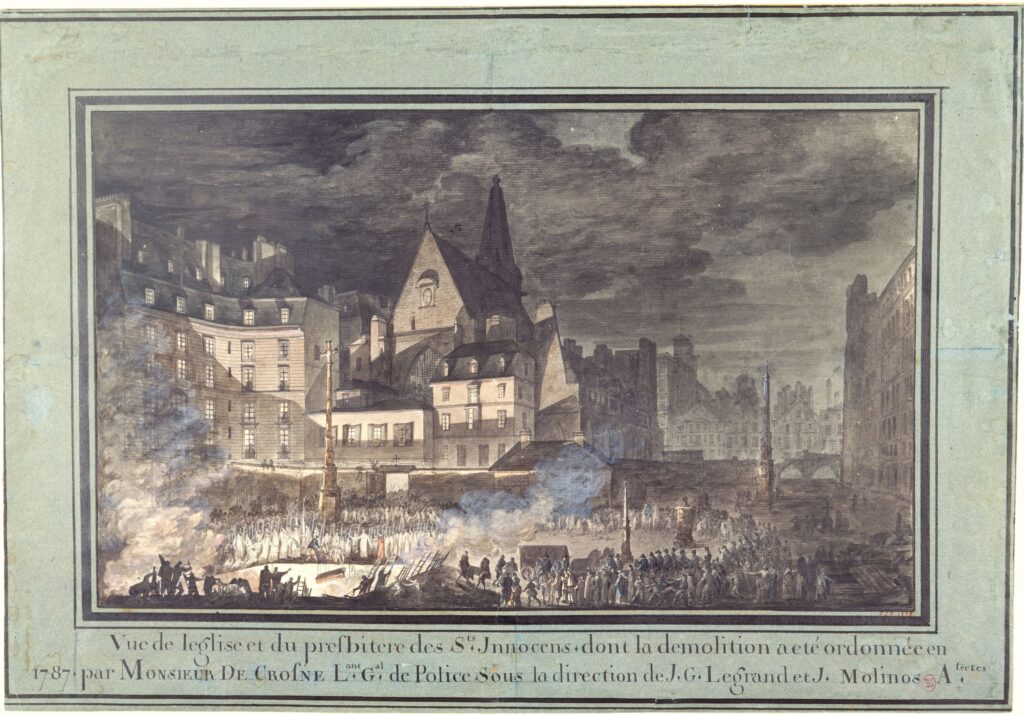
On April 7, 1786, with the work under way, the site was blessed and consecrated as the Paris Municipal Ossuary. From the start it was known by a grander name, the Catacombs, after the ancient catacombs of Rome. The Saints-Innocents was only the first cemetery emptied. Over the following decades, Paris closed its other old parish graveyards, and their bones followed. The last came down in 1860.
The Empire of Death
Visitors came almost at once. The Count of Artois, the future King Charles X, went down in 1787 with a party of ladies from the court, while bones were still arriving. In 1809, the ossuary opened to the public by appointment, and the visitors’ book at the end of the route filled up fast.
From 1810 to 1814, the quarry inspector Louis-Étienne Héricart de Thury rearranged the piles of bones into the walls and monuments visitors walk past now. Over the doorway into the ossuary, he set a line of French verse: “Arrête! C’est ici l’empire de la mort.” Stop! Here is the empire of death. The line comes from the poet Jacques Delille’s 1804 French translation of Virgil’s Aeneid. In the poem, it is what the ferryman of the river Styx says when the hero Aeneas reaches the edge of the underworld.
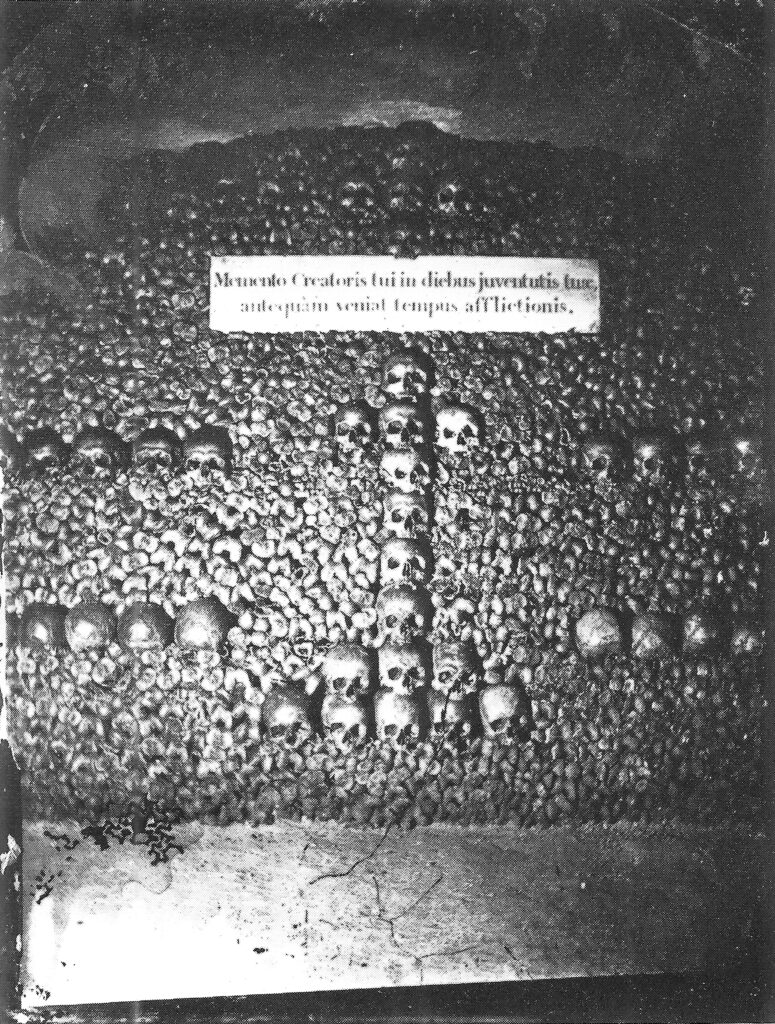
Past the door, the bones are stacked into walls known as hagues: leg bones laid with their joint ends facing the passage, crossed by bands of skulls. The City of Paris counts 217 of these walls. Behind them, a jumble of smaller bones stretches back more than 10 meters into the dark. The writer Peter Ross toured the ossuary for an essay in his newsletter, Small Finds. He writes that none of the skulls have their lower jaws, because they broke off when the bones were tipped down the shafts.
Who Lies Here
How many people are down there? News stories and tour companies usually say six million. The City of Paris says “several million” women, men, and children. Peter Ross gives the usual figure and then doubts it: “I say six million. But it could be three. Or four million, or five. Nobody knows for sure.”
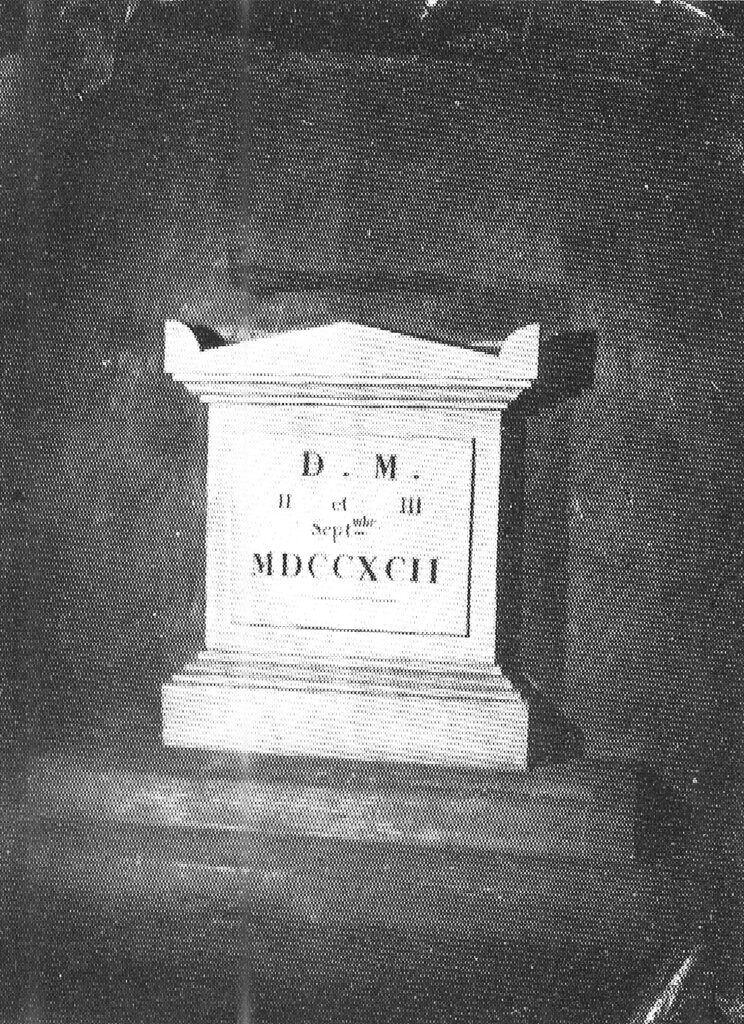
The ossuary also holds victims of a massacre. The French monarchy fell in August 1792. Within weeks, panic spread among the sans-culottes, the working-class radicals of revolutionary Paris. They feared the political prisoners in the city’s jails were plotting an uprising. Over five days, from September 2 to 6, the sans-culottes killed more than 1,000 prisoners. Among the dead were more than a hundred priests who had refused to swear an oath to the new constitution. They had been held in a former Carmelite convent turned prison. Some of those priests lie in the Catacombs, in a wall of bones called the Wall of the September Martyrs. Nearby, a memorial stone carries the only Greek on the route, a line from Homer’s Odyssey: “It is an impiety to insult the dead.”
Ross’s guide was the Catacombs’ head of communications, Hélène Furminieux. She told him about the dead of the Terror, the wave of executions that came later in the Revolution. “A lot of those who were guillotined during the Terror are here,” she said. “And the people who ordered their execution are also here. So they are reunited in death, not as lovers, but as people who hated each other.”
Closed and Reopened
Nearly 600,000 people a year were coming down, and the City of Paris decided the fragile site needed protecting. It began restoring the Catacombs in the fall of 2023, and the first wall it rebuilt was the Wall of the September Martyrs. On November 3, 2025, the Catacombs closed for five months to finish the job.
The ossuary reopened on April 8, 2026, with a new route through 1.5 kilometers of tunnels, 20 meters underground. The new audio guide is told in character as Héricart de Thury, the inspector who arranged the walls more than 200 years ago.
Hauntings & Lore
The stories told about the Catacombs reach well beyond the ossuary, into the 280 kilometers of old quarry tunnels that the French Interior Ministry counts under the city. Those closed quarries have been off limits to the public since 1955, because of the risk of getting lost, of cave-ins, and of falling down shafts. The first story, though, happened in the ossuary itself, on the night musicians went down to play for the dead.
Music for the Dead
On the night of April 2, 1897, about a hundred guests went down into the ossuary for a secret concert. It was by invitation only. Two days later, the newspaper Le Figaro reported on the concert, and its story printed the invitation the guests had received. They were let in from 11 p.m., and their carriages were asked not to stop at the door. The music was played in the Crypt of the Passion, around a barrel-shaped pillar of bones. Some 50 musicians from the Paris Opéra and two of the city’s concert orchestras played a program that included Chopin’s funeral march and Saint-Saëns’s Danse Macabre. A drawing published at the time shows the audience in top hats and flowered hats, seated among the skulls.
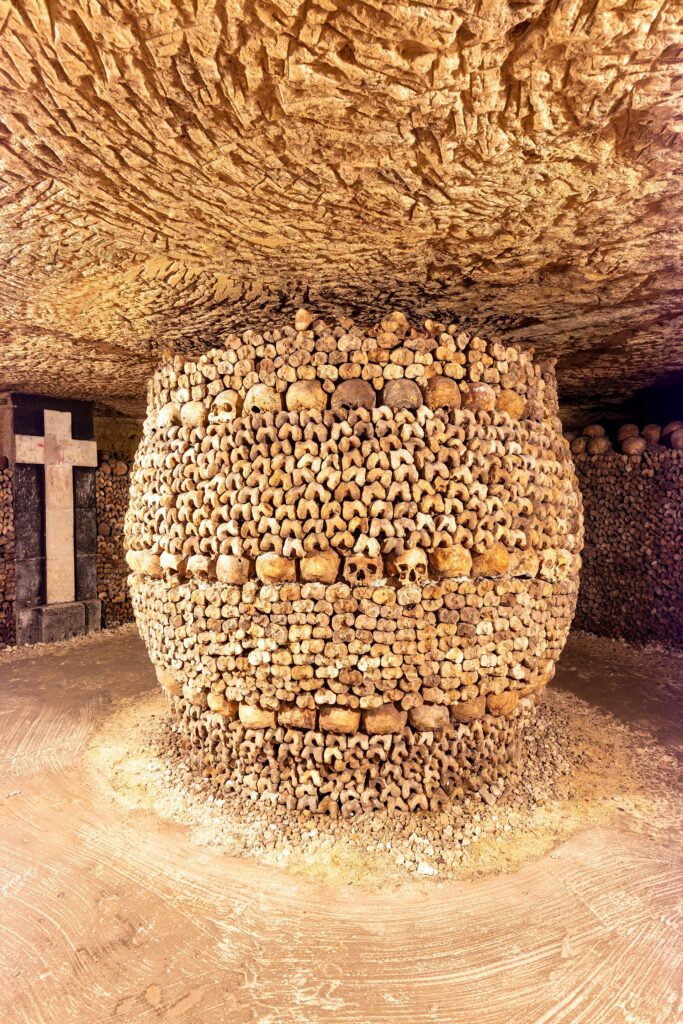
The dead had another concert in the summer of 2025, when the American rock band Queens of the Stone Age was given permission to play in the Catacombs. There was no audience, just the band and its crew, and the set became an EP, Alive in the Catacombs. The band’s singer, Josh Homme, told Peter Ross about it in a video call for the same Small Finds essay. “It felt like trying to entertain people who don’t get much entertainment, to show love to a group who are almost forgotten,” he said.
The Tape in the Dark
The Catacombs’ best-known modern legend is a piece of found footage. The story goes that in the early 1990s, a man went down alone into the closed quarries with a video camera. Some years later, the camera turned up lying in the dark, with the tape still in it. It was found by cataphiles, the explorers who sneak into those tunnels. On the tape, he is alone and lost, with no idea how to get out, and the camera is his only light. Then he drops it. It lands in a puddle, films his feet running away, and keeps recording until the tape runs out. Nobody knows who he was, or whether he ever found his way out.
The tape first reached the public on October 24, 2000, on the American TV series Scariest Places on Earth. Francis Freedland, the documentary filmmaker featured in the episode, said he had the tape from the cataphiles who found the camera. Only about a minute and a half of it has ever been shown. Freedland told the ghost-hunting show Ghost Adventures in 2014 that he had never been able to identify the man.
In 2018, the blog The Ghost In My Machine went looking for a newspaper report of the man’s disappearance or of the camera’s discovery, and couldn’t find one. Its writer finds the whole story far-fetched, but adds: “It’s not impossible that someone could get lost under there and never be found.”
People really do get lost down there. In June 2017, two teenagers, 16 and 17, spent three days in the closed tunnels before rescue dogs found them.
Voices at Midnight
The Tour Guy, a company that leads tours of the Catacombs, tells one more legend, which it suggests may be connected to the lost man’s tape. In this one, the walls of the ossuary begin to speak after midnight. Disembodied voices try to persuade you to go deeper into the tunnels, until you can’t find your way out again.
The Lost Doorkeeper
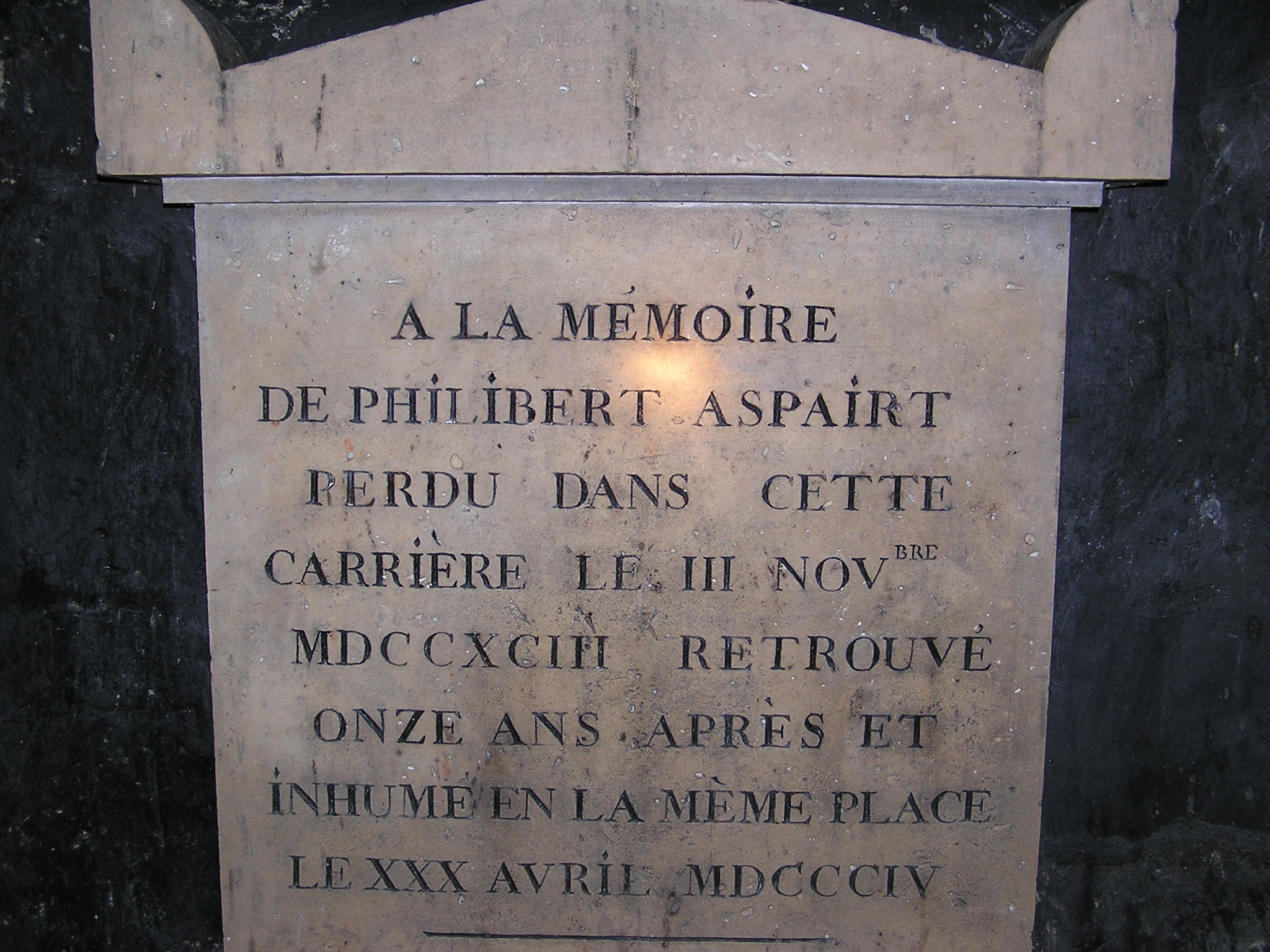
The tunnels’ most famous lost man is Philibert Aspairt. He was a real man. His death record calls him a quarry worker, and he went missing in the early 1790s, during the French Revolution. His remains were found in the quarries in 1804. His page tells the mystery of how anyone knew the remains were his. Legend makes him the doorkeeper of the Val-de-Grâce, an abbey the Revolution had just turned into a military hospital. The legend sends him into the tunnels after the Carthusian monks’ famous liqueur, Chartreuse, kept in the cellar of their monastery near the Luxembourg Garden. A stone to his memory, put up years later, stands in the closed tunnels. It says he was lost there on November 3, 1793, and buried in the same place. Some cataphiles say his ghost walks the tunnels every November 3. On November 3, 2025, of all days, the Catacombs closed for their renovation.
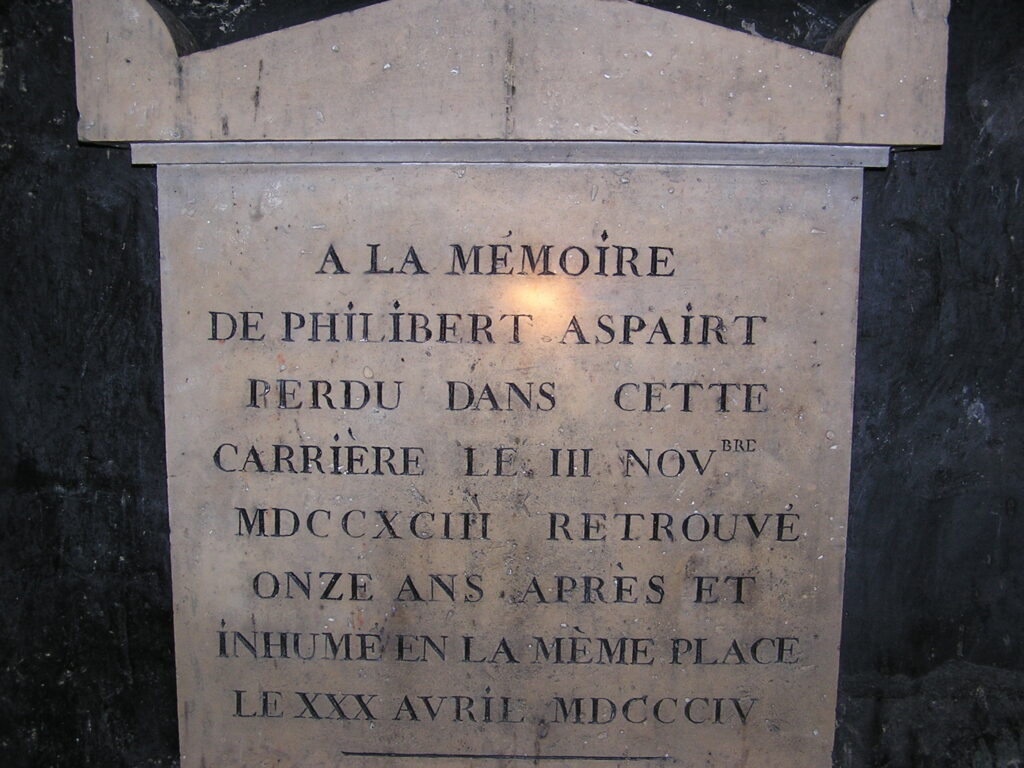
Philibert’s stone is off limits, but the ossuary is open. Guided tours from LivTours, ExperienceFirst, and The Tour Guy come with reserved entry and take visitors into restricted rooms that ordinary ticket holders don’t see.
Visit
Visiting Catacombs of Paris
- Official visitor info: Catacombes de Paris
- How to visit: Open to the public with a timed ticket from the official site, which also has the hours and prices. Guided tours from LivTours, ExperienceFirst, and The Tour Guy come with reserved entry and go into rooms on the route that are closed to ordinary ticket holders.
- Finding the story sites: The line “Arrête! C’est ici l’empire de la mort” is over the doorway at the start of the ossuary. The barrel of bones where the 1897 concert was played stands in the Crypt of the Passion. The stone for the September 1792 massacre is to the right of plot No. 116. Philibert Aspairt’s stone is not on the route: it is in the closed tunnels.
- Rules worth knowing: The route runs one way, from the entrance on the place Denfert-Rochereau to the exit on the avenue René-Coty, and you can’t turn back. Don’t touch the bones: taking one carries a fine of up to 15,000 euros and up to a year in prison, and staff check bags at the exit. The rest of the quarries have been closed by law since 1955, and going in carries a 135-euro fine.
- Worth knowing: The museum that runs the Catacombs told the French news agency AFP in 2017 that nobody had ever got lost on the part open to the public. The places in the legends (Philibert’s stone, the tunnels of the lost cameraman) are all in the closed quarries.
Location
1 Av. du Colonel Henri Rol-Tanguy, 75014
Been here?
Tell us what happened.
Related People
-
Philibert Aspairt
Philibert Aspairt, a workman, vanished into the tunnels under Paris during the French Revolution, and his remains lay undiscovered for a decade… read more
Dig Deeper
On TV
1 episode- Ghost AdventuresNetherworld: Paris Catacombs Episode page2014
Books About Here
-

The Catacombs of Paris
The History of the City’s Underground Ossuaries and Burial Network. read more
Contributors

Sources (9) including 1 record of the time · 1 record of the time
Records of the Time 1
Newspapers, records, surveys, and photographs made when it happened.
-

The French national library's digital archive: Le Matin, April 3, 1897, and Le Figaro, April 4, 1897, on the concert in the ossuary.
Histories and References 4
What historians, museums, historical societies, and official bodies have written since.
-

paris.fr
The Catacombs' official site, [catacombes.paris.fr](https://www.catacombes.paris.fr/en): its site history and chronology, its visit recommendations, and its notice of the closure for works from November 3, 2025. And the City's own page, [A new tour route for the Catacombs of Paris!](https://www.paris.fr/en/pages/the-catacombs-of-paris-reopen-to-the-public-on-april-8-34816), updated April 15, 2026.
-

Le linteau de l'entrée de l'Ossuaire: les traductions latin-français
L'Ossuaire des Catacombes de Paris · Gilles Thomas and Xavier Ramette, May 14, 2012
-

Dangers liés aux explorations illicites dans les catacombes de Paris
French Senate · written question no. 03710, answer of the Interior Ministry, June 5, 2025
-

List of Ghost Adventures episodes
Wikipedia
News, Lore, and Guides 4
Later reporting, ghost lore, and the places and guides that tell the stories.
-

Small Finds · Peter Ross, January 4, 2026
-

Teenagers rescued after 3-day ordeal in Paris catacombs
France 24 · AFP, June 14, 2017
-

Unresolved: The Missing Man in the Paris Catacombs
The Ghost In My Machine, April 23, 2018
-

Chilling Legends & Myths About the Paris Catacombs
The Tour Guy