
On This Page
History
In 1955, the Davenport House was slated for demolition to make way for a parking lot. Seven Savannah women halted it, bought the house, and founded the Historic Savannah Foundation. The city’s organized preservation movement grew out of that fight. By then, the brick house on Columbia Square had already been a master builder’s home, a widow’s boarding house, and a run-down tenement.
Savannah’s Master Builder
Isaiah Davenport was born in Little Compton, Rhode Island, in 1784 and trained as a master builder, a job the museum in his house likens to a general contractor today. He likely arrived in Savannah around 1807, married Sarah Clark there in 1809 and served on the city’s Board of Aldermen from 1817 to 1822. Legend has it there was once a Davenport-built house on every square in the city. In 1820, he finished his own, on Columbia Square at the corner of State and Habersham streets.
He didn’t build it alone. The museum says the house went up with the work of two men Isaiah enslaved, Ned and Davey. Ned was a carpenter, bought in 1813, who worked on many other Savannah houses as part of Isaiah’s crew. Davey, also called Dave, was a wagon driver. Isaiah’s brother Samuel had bought him in 1817, and Dave had lived with Isaiah and Sarah only a short time when he ran away in January 1822, after Samuel’s death. Isaiah offered a $100 reward in the Savannah Republican, a city newspaper, describing him as “well known in Savannah, for the last three years as a waggoner.” The museum says Dave stayed on the run for at least eight months.
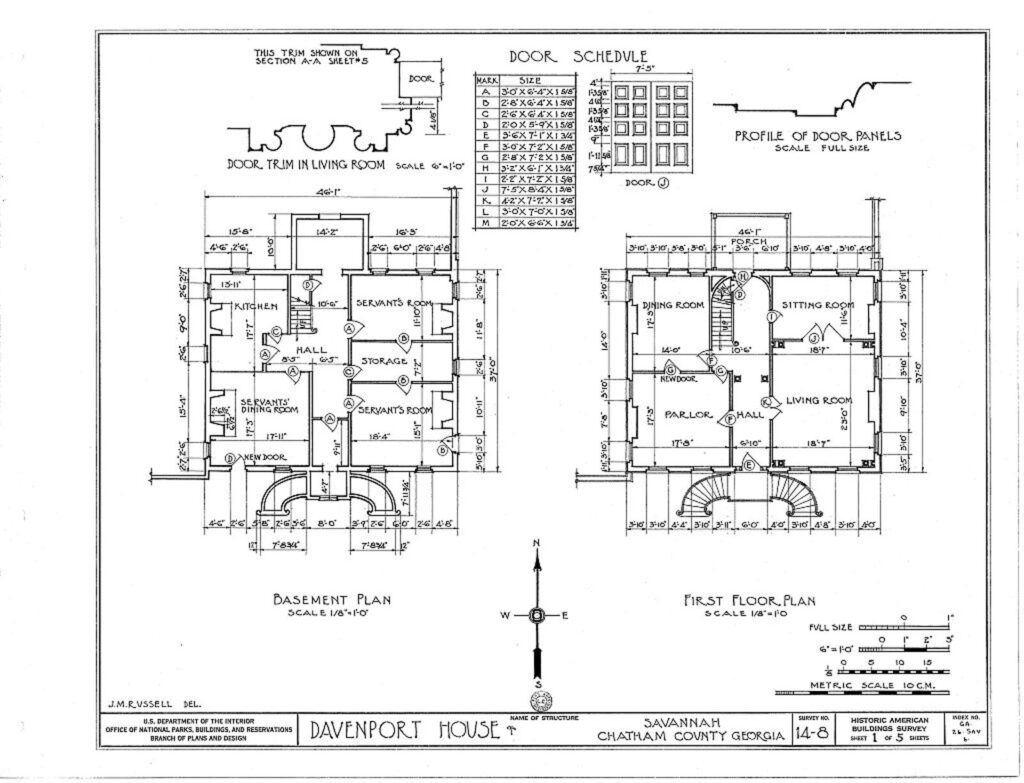
As many as 13 enslaved people lived and worked in the Davenport household between 1812 and 1828, by the museum’s count. The family’s public rooms were on the first floor and their bedrooms on the floors above. The basement held the kitchen, storage and work space, and possibly a sleeping area for the people Isaiah enslaved.
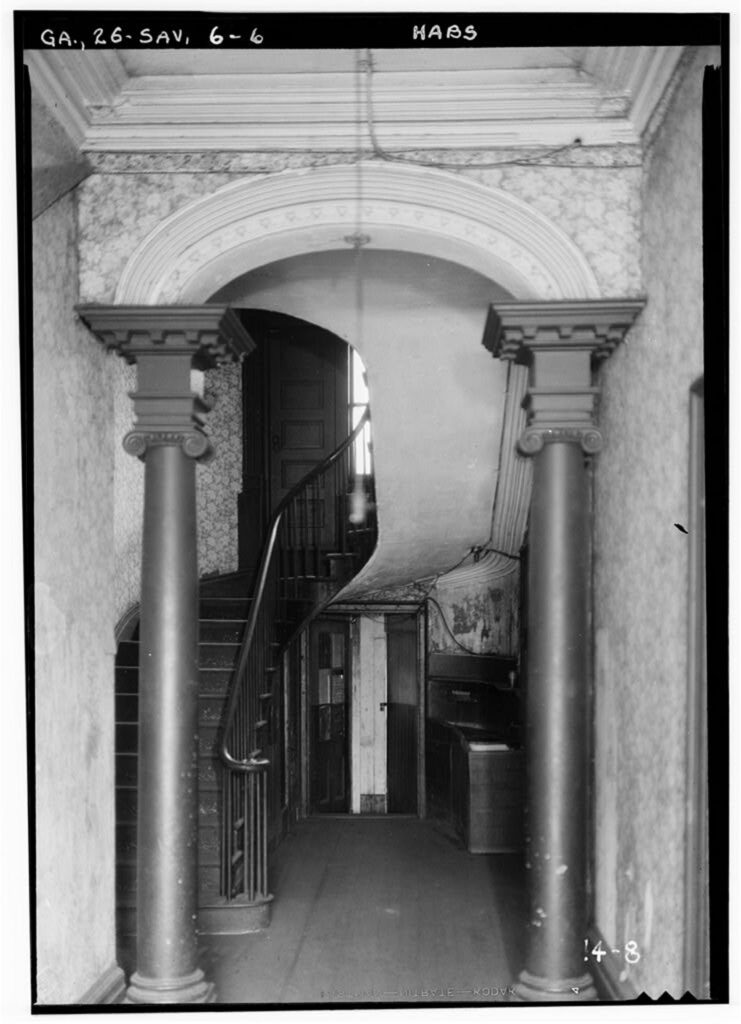
Someone signed the plasterwork. The top of the arch in the east room is inscribed “George Smith, September 1822,” the Historic American Buildings Survey recorded. The survey, a National Park Service program, drew the house’s floor plans in 1934.
A Widow’s Debts
Isaiah died of yellow fever in 1827, at 43. Sarah was eight months pregnant with their 10th child, and he left the estate heavily in debt. That fall, she advertised in the Savannah Georgian, another city paper. The notice said Mrs. Davenport “has determined not to rent the House” and would open “a private Boarding House on the 6th of November” for “either single gentlemen or families.” A silhouette made of her the next year shows her holding a book and a quill, which the museum reads as a nod to the fact that she could read and write.
Isaiah’s debts were settled at auction. On April 7, 1828, the Georgian announced a sheriff’s sale at the courthouse for the first Tuesday in May. Up for sale were a lot in Columbia Ward and nine people, each listed by a first name. They were Ned, Davy, Bella, Jack, Jacob, Isaac, Polly, Peggy, and Nancy. Lot and people alike were “levied on as the property of Isaiah Davenport, to satisfy an execution in favor of Robert Mitchell,” which means seized under a court order to pay one of his creditors.
Bella and her four children, Jack, the twins Jacob and Isaac, and Polly, had come to the household in 1817, when Polly was about a year old. At the sale, Sarah bought all five back, and the museum says they stayed together for much of their lives, though Sarah later put up Bella and the twins as collateral for loans. Ned, who had helped build the house, was not bought back, and what became of him after 1828 is unknown. Sarah sold Dave to a man named Aaron Champion, and Dave stayed with Champion for the rest of his life. He died in 1856.
Sarah ran the boarding house for 13 years. In 1840, she sold the house to William Baynard, a planter from Hilton Head, South Carolina, for $9,000, and his descendants owned it until 1955. In 1866, she was running another boarding house, on Broughton Street next to The Marshall House, and she died in 1869 at 81.
The Tenement Years
From 1890 to 1955, the house was a string of poorly kept apartments, sometimes with a whole family living in a single room. Kristine A. Chase, in a 2008 master’s thesis for the Savannah College of Art and Design, found businessmen, Irish and Chinese immigrants, and war widows among the tenants.
Robert Chung Chan was one of them. Born Chung T’ai Peng, he arrived in 1889 as one of Savannah’s first Chinese immigrants. He and his wife, Annie, lived in the house in 1901 and 1902 and ran a Chinese laundry in what is now the Historic Kennedy Pharmacy, the museum’s entrance today. The museum has since built an exhibition around the family’s photographs and stories, Old Chan Magic: Chinese Roots, Southern Branches.
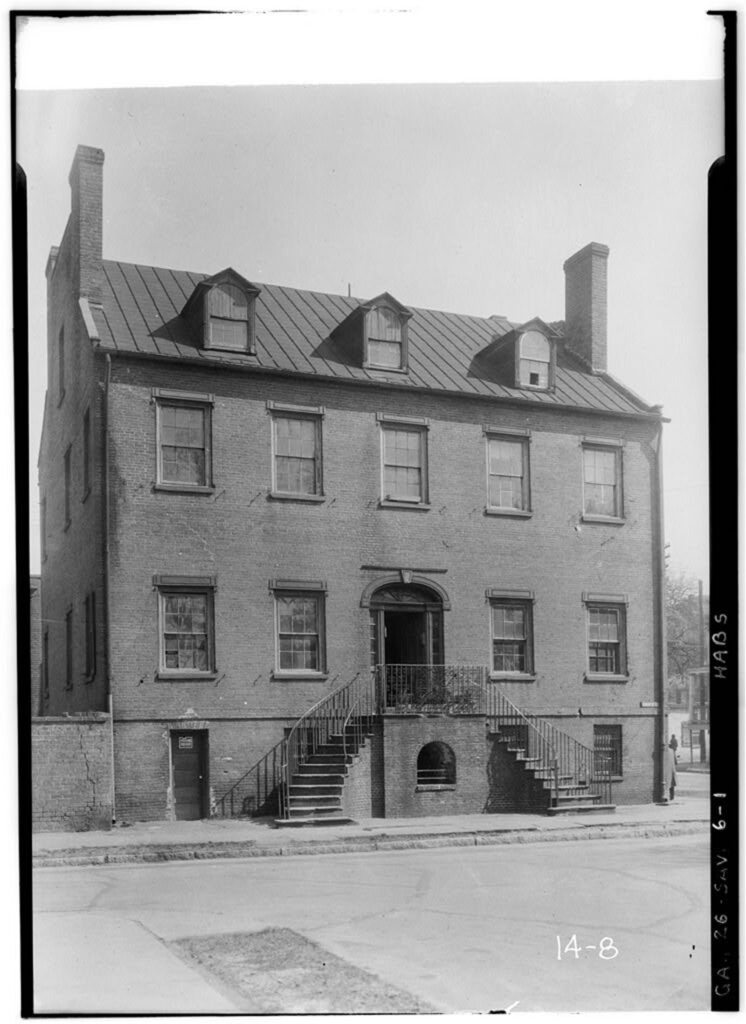
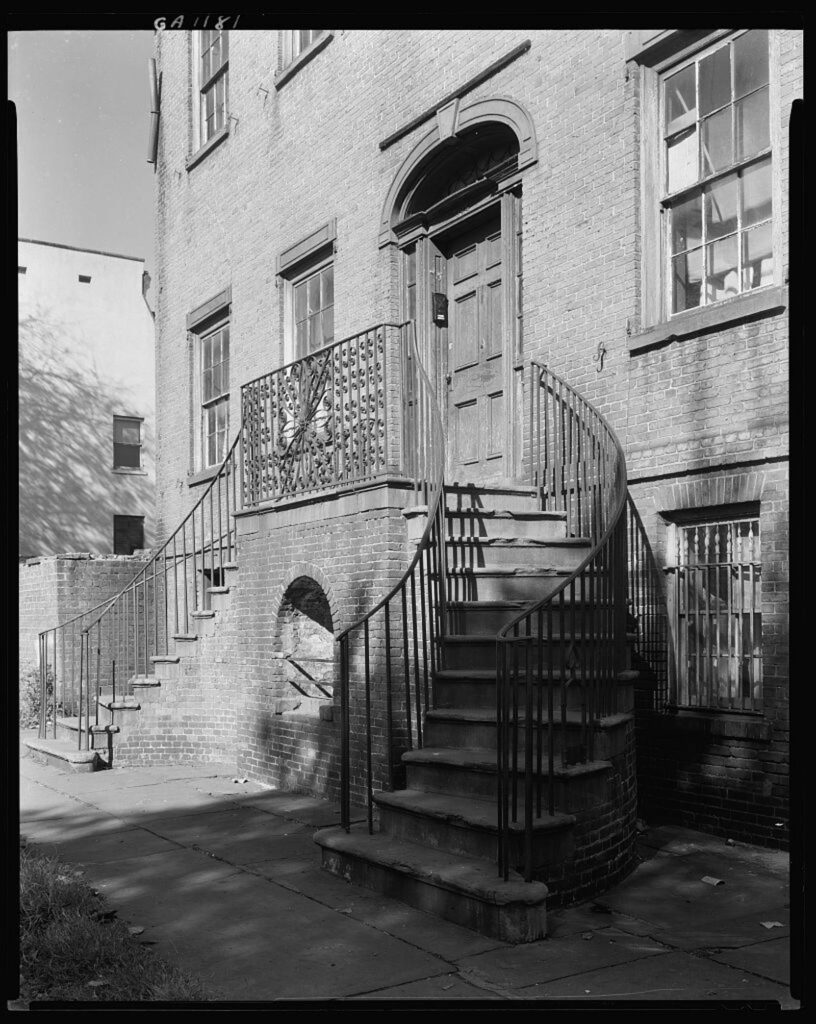
The Historic American Buildings Survey photographed the house in the 1930s and rated its condition “Poor.”
Saved From a Parking Lot
The parking lot was wanted by a funeral home, as one neighbor tells it. The Goette Funeral Home was then in the Kehoe House, on the same square, and had no lot of its own. “The reason the Davenport House was saved was because the Kehoe House funeral parlor (Goette) wanted to build a parking lot,” Margaret Eden told the Savannah Morning News in 2003. She was the general manager of the inn the Kehoe House had become.
Anna Colquitt Hunter, an art critic and painter who had directed Red Cross clubs in North Africa and Italy during World War II, brought six other women together to save the house. Historic Savannah Foundation calls them its Seven Ladies. They halted the demolition, bought the house, and founded the foundation. The house became its first headquarters. The museum calls the house the city’s “line in the sand,” the sign that no more historic buildings would come down without “a fight.”
The foundation restored the house from 1956 to 1960 and opened it as a museum in 1963. A second restoration, from 2000 to 2003, won a Preserve America Presidential Award in 2005.

Hauntings & Lore
The Davenport House Museum doesn’t tell ghost stories. Savannah’s ghost-story writers have told two about the house for decades, a cat that isn’t there and a little girl upstairs. The cat came from a man who lived here in the tenement years.
The Yellow Cat
Robert Chung Chan’s daughter, the Savannah poet Gerald Chan Sieg, told the story to the author Margaret Wayt DeBolt, who printed it in her 1984 collection Savannah Spectres and Other Strange Tales. Sieg had written ghost stories for years, DeBolt wrote, but had never told this one. She said her father had been a young revolutionary against China’s Manchu dynasty who fled to save his life.
One afternoon, as he came home from work and walked up the front steps, “a large yellow cat ran in front of him.” He had never noticed a cat there before. When he opened the door, “the cat shot through the open door, and disappeared down the hallway,” and the others in the house came out to help him look for it. “It would have been impossible for that cat to get outside again without being seen,” Sieg said, “yet no sign of it was ever found.” Then she wondered: “Do you suppose the Davenports had a yellow cat? With seven children, they probably did!”
The cat outlived the tenements. James Caskey, author of Haunted Savannah (2005), writes that members of the museum’s staff have seen it in several rooms, “often times darting from room to room.” He writes that children have been known to call a cat no one else can see, and that one child was seen stroking the air as if petting it. He describes it as an orange and white tabby. When he wrote, the gift shop downstairs sold a plush ghost cat. In Alan Brown’s Haunted Georgia (2008), it’s a large Persian that runs into the gift shop ahead of visitors. The cashier laughs and tells them no cat has lived in the house since it became a museum.
The Girl Upstairs
Alan Brown tells this one too. Some years before his book came out, the house put on an exhibit of Victorian toys. Near dusk one day, as the cashier was getting ready to close up, two women came down from upstairs and asked, “What about the little girl upstairs?”
“There is no little girl upstairs,” the cashier said.
One of the women insisted. “Yes, there is. She is playing in one of the rooms with the toys.”
Worried that a child had been separated from a tour, the cashier went up with them, but “the upstairs rooms produced no little girls.” As the two women walked to their car, one of them looked back and saw a little girl looking down at her from the middle window. Many people have seen “a little blond girl in a white Victorian lace dress” at that window, Brown writes, and in the rocking chair upstairs.
He says she “is believed to be the ghost of Laura Davenport, who ran down the stairs one day after playing with her dolls and tripped and fell.” In his telling, she never woke from the coma that followed. Savannah Terrors, a local ghost tour company, says the museum’s staff are “pretty sure” she died of yellow fever.
Isaiah and Sarah’s 10 children are all on the museum’s list, and none of them is named Laura. The three who died young, of what the museum calls now-preventable diseases, died in 1813 and 1814, before the house was built. The only daughter born after them, Cornelia, grew up, married, and died in childbirth in 1853. The one Laura in the museum’s history is a building: Laura’s Cottage, which may have been the first thing Isaiah built in Savannah, in 1808.
No Ghost Stories on the Tour
The museum has its own answer to the city’s ghost tours. Almost every October since 2003, its staff has staged a re-enactment of the 1820s yellow fever epidemic, the disease that killed Isaiah. The playwright Raleigh Marcell had co-produced the program from the start. “This is not a haunted house. There are no ghost stories,” he told the local weekly Connect Savannah in 2015.
The museum’s director, Jamie Credle, told the Savannah TV station WSAV in 2019 that the idea was to “complement the ghost tour industry with something that’s a little bit different.” For October, she told Connect Savannah in 2022, “we couldn’t think of anything quite as frightful as Yellow Fever.”

Visit
Visiting Davenport House
- Official visitor info: Davenport House Museum
- How to visit: Tours: guided tours only, with tickets from the museum. Tours start in the museum shop in the Historic Kennedy Pharmacy, 323 E. Broughton St.
- Finding the story sites: The front steps, where Robert Chung Chan met the yellow cat in his daughter’s story, are on State Street. The museum shop, where tours start, is in the building where he and Annie ran their laundry.
- Worth knowing: The house tour is history only: the museum doesn’t tell the stories of the cat or the girl upstairs.
Location
323 E Broughton St, Savannah, GA 31401
Been here?
Tell us what happened.
Dig Deeper
Tours That Stop Here
Sinister Sins & Shadows: A Savannah Ghost Tour
by Savannah Terrors
1 hrFrom $26★ 4.3 · 102 reviews
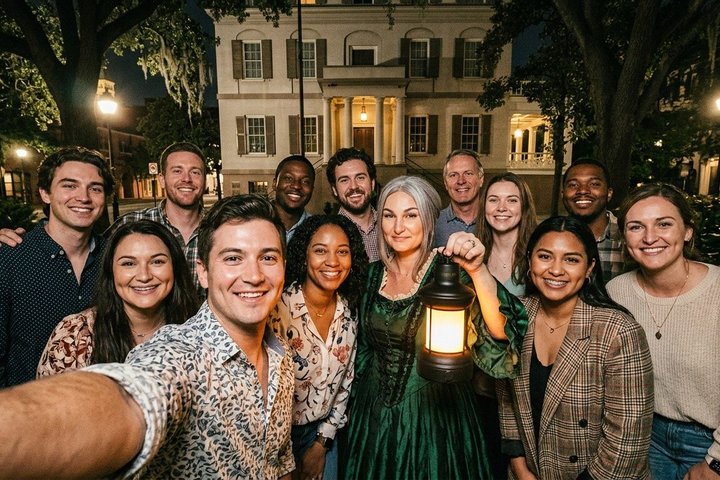
Family Friendly WalkingAn evening walk past Wright Square and the Owens-Thomas House, telling the history behind Savannah’s ghost stories in a way that suits kids too. see tour
Book on Savannah Terrors
Contributors


Sources (10) including 2 records of the time · 2 records of the time
Records of the Time 2
Newspapers, records, surveys, and photographs made when it happened.
-

the Savannah Republican, January 16, 1822 (Isaiah Davenport's notice for Dave), and the Savannah Georgian, October 31, 1827 (Mrs. Davenport's boarding house) and April 7, 1828 (the sheriff's sale)
-

loc.gov
Historic American Buildings Survey GA-14-8: drawings (1934), photographs (1930s and 1962) and data pages; Frances Benjamin Johnston's photographs of the house, 1939 or 1944
Histories and References 2
What historians, museums, historical societies, and official bodies have written since.
-

the house, the Davenport family and children, the timeline, We Know Their Names (Ned, Dave and Bella), the tenement era and the Chan family, the Seven Ladies, preservation, and visiting
-

Colonial Town Gate; Davenport House
Georgia Historical Society · marker, 1959
News, Lore, and Guides 6
Later reporting, ghost lore, and the places and guides that tell the stories.
-

Margaret Wayt DeBolt, *Savannah Spectres and Other Strange Tales* (1984); James Caskey, *Haunted Savannah* (2005); Alan Brown, *Haunted Georgia* (2008)
-

infoweb.newsbank.com
the Savannah Morning News: Chuck Mobley, "Chinese took quiet path to success in Savannah" (October 15, 2006), and Ben Werner, "Rebirth for an old corner" (August 1, 2003)
-

Jessica Leigh Lebos on the museum's October programs (2015), and the museum's 2022 yellow fever experience
-

-

Savannah Terrors
-
