
On This Page
History
Tomochichi’s Grave
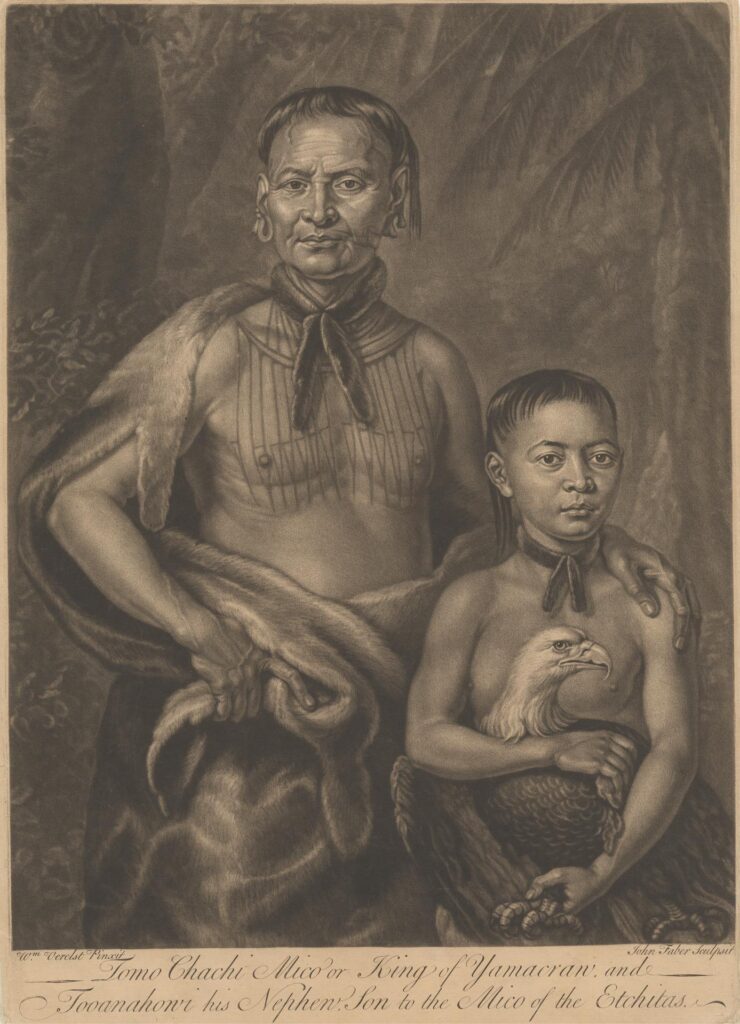
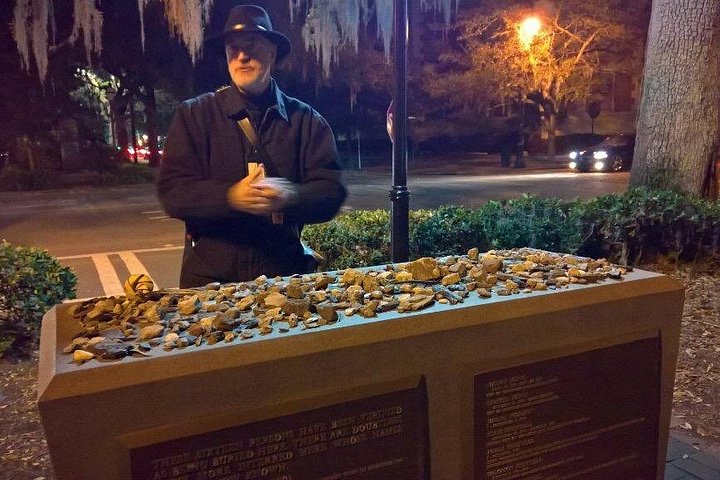
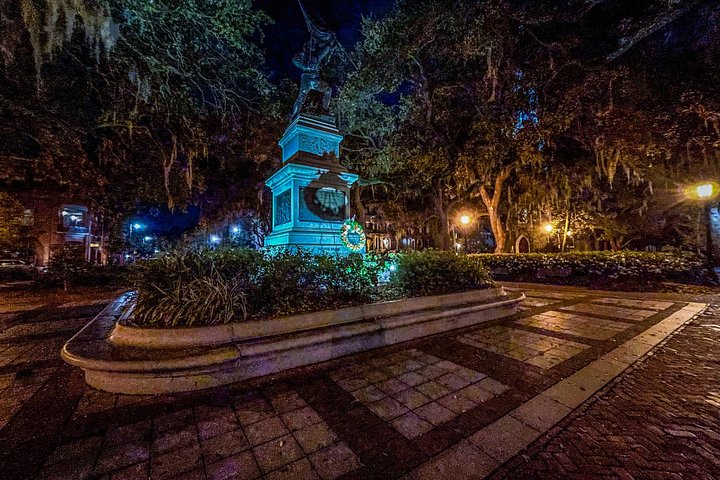
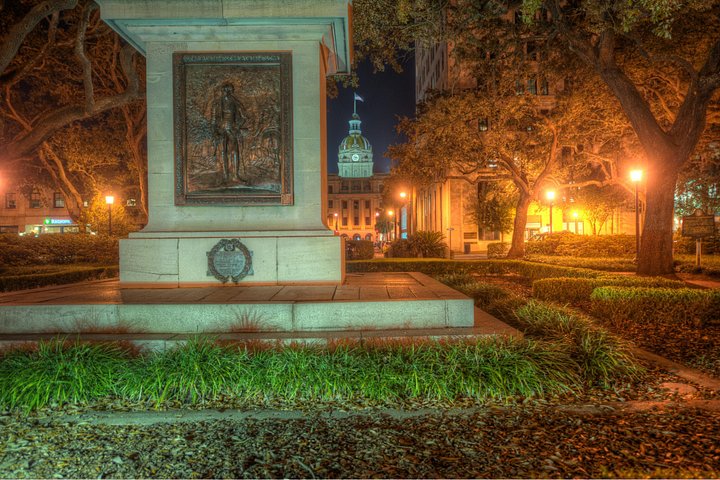
During the first five years of British settlement, Tomochichi, the leader of the Yamacraw people, gave the new colony “invaluable assistance,” the New Georgia Encyclopedia says. He died on October 5, 1739. The colonists honored him with a British military funeral and marked his grave, in what is now Wright Square, with “a Pyramid of Stone” gathered nearby.
The stones were removed in the early 1880s. In 1899, a large granite boulder with a copper plate was set in the square to replace them, southeast of where the old marker had stood. The Georgia Historical Commission later added a marker of its own that tells what Tomochichi did for the colony.
The Hanging Square
Wright Square was one of the first four squares laid out in Savannah. The town’s first courthouse and jail stood across the street, and that, Emerald Coast Magazine says, is why it became known as the Hanging Square.
Hauntings & Lore
The square’s best-known ghost is a young mother the colony hanged in 1735. Her story survives in a handful of letters the colonists wrote home, and they are stranger than the legend.
Alice Riley
The Murder of William Wise
William Wise was a farmer who had come to Georgia in December 1733. That winter, he lay sick in bed “over in the Island,” as a colonist named Thomas Christie wrote to James Oglethorpe, the colony’s founder. Two Irish servants worked for him, Alice Riley and Richard White. Every morning, Wise called for water to wash, and White combed out his hair, “in which he took a great deal of Pride,” while Wise leaned his head out over the side of the bed.
On March 1, at White’s direction, Riley set a pail of water down by the bed. White came in as if to comb Wise’s hair. Instead, he took hold of the handkerchief Wise wore around his neck and twisted it “till he was almost Suffocated,” Christie wrote, while Riley “plunged his Face into the Pail of Water.” Wise was “very weak,” and “it Soon Dispatched him.”
The Gallows
Riley was pregnant. She was sentenced on May 11, 1734, and her hanging waited until her child was born.
That winter, White broke out of prison. Edward Jenkins, a stocking maker, was at work on his lot with two neighbors when one of his men pointed out a man going “very fast.” The three went after him with the only weapons they had, “two hooks & an ax.” It was White. He begged for his life, and told them he would sooner “perish in ye woods rather then dye on the Gallows.” He had been looking for “ye woman,” he said, and thought he had left her a little way off. The colony later paid the three men a reward “for Retaking the Murderers.”
White was taken straight to the gallows. He swore to the end that he was not guilty. On January 19, 1735, about six weeks after giving birth, Alice Riley was hanged, still denying the murder. By March, her son, James, was dead too.
Was It Here?
None of the letters says where the gallows stood. Tradition puts it in Wright Square, and WSAV, a Savannah TV station, calls Riley the first woman executed in Georgia and says she met her fate here. For a later hanging, the colony ordered a gallows built “on the Bluff, towards the Extremity of it, near the Water,” William Stephens wrote in his journal of the colony.
The Woman Looking for Her Baby
Guide Enocha Edenfield told WSAV that people “believe that she still wanders this square.” The visitor guide Savannah.com says sightings of “a pale, redheaded woman begging for help finding her baby are common in Wright Square.” In 2017, the TV series Haunted Towns brought its ghost hunters to the square and the surrounding shops. The show tied them all to Alice Riley’s ghost, still searching for her child.
Edenfield says others have “picked up on other spirits” here too, perhaps because “our first burial ground was actually off of this square.”
Visit
Visiting Wright Square
- How to visit: Open to the public: a city square, open at all hours.
- Finding the story sites: Tomochichi’s granite boulder and the state marker for his grave, in the square.
- Worth knowing: No record says where Alice Riley was hanged. The tradition puts it here.
Location
Bull Street, Between West State and West York Streets
Been here?
Tell us what happened.
Dig Deeper
On TV
1 episode- Haunted TownsSavannah2017
Tours That Stop Here
Bad Kitty Haunted Savannah Pub Crawl – Spooky, naughty ghosts
by Mad Cat Tours
2–2.5 hrFrom $34.99★ 4.7 · 142 reviews
Adults Only (21+) Pub Crawl WalkingA 21-and-over haunted pub crawl of Savannah’s love-gone-wrong ghost stories, aimed at couples and bachelorette groups. see tour
Book on ViatorFraidy Cat: The Family Fun Ghost Tour of Savannah
by Mad Cat Tours
1.5–2 hrFrom $29.99★ 4.8 · 352 reviews
Family Friendly WalkingMad Cat Tours’ family ghost walk, playful rather than scary, through Savannah’s famous ghosts, cemetery lore, and haunted mansions. see tour
Book on ViatorSavannah Ghostwalker Tour and Ghost Hunt
by Savannah GhostWalker Tour and Ghost Hunt
2 hrFrom $35★ 4.9 · 735 reviews
Adults Only (16+) Investigation WalkingA small-group walk for 16 and up through Savannah’s history and ghost stories, with EMF meters to hunt for activity along the way. see tour
Book on ViatorSpirits & Scoundrels Ghost Tour
by Destination Ghost Tours
110 minFrom $34.99★ 4.8 · 594 reviews
Adults Only (18+) WalkingDestination Ghost Tours’ 18-and-over walk through Savannah’s darker stories of crime, scandal, murder, and voodoo. see tour
Book on ViatorSpooky Savannah Haunted Bar Crawl
by Spooky Savannah Ghost Tours
105–120 minFrom $34.70★ 4.7 · 1,020 reviews
Adults Only (21+) Pub Crawl WalkingA bawdy, 21-and-over crawl through Savannah’s haunted bars and taverns, mixing ghost stories, history, and drink specials. see tour
Book on ViatorSavannah America’s Most Haunted City® Walking Ghost Tour
by 6th Sense World
1.5 hrFrom $32★ 4.6 · 46 reviews
Walking Ages 13+A walk through about a dozen of Savannah’s oldest squares, telling the stories behind the city’s 2002 “America’s Most Haunted City” title. see tour
Book on ViatorGenteel and Bard’s Savannah Dark History and Ghost Encounter Walking Tour
by Genteel and Bard
110 minFrom $35★ 4.8 · 1,777 reviews
Walking Ages 13+A night walk through Savannah’s lamp-lit historic district, its haunted houses and old cemeteries, for ages 13 and up. see tour
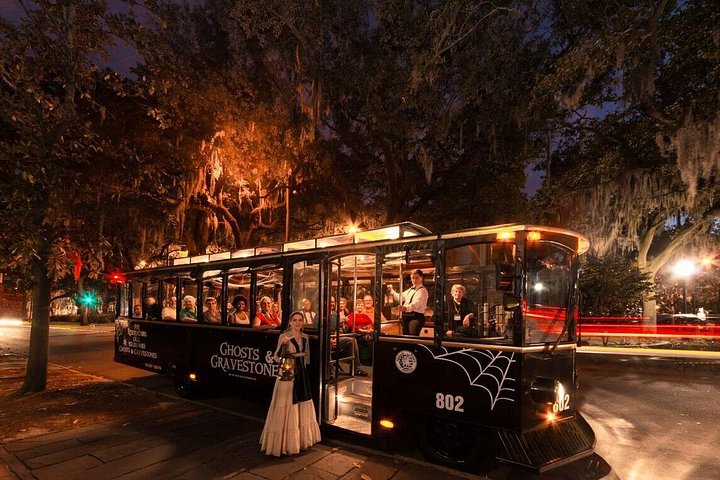
Book on ViatorGhosts & Gravestones Trolley Tour
by Ghosts & Gravestones of Savannah
75 minFrom $42.80★ 4.1 · 3,510 reviews
TrolleyA trolley tour of Savannah’s haunted side, with stops inside the Andrew Low House and a River Street ship chandlery, rated PG-13 by the company. see tour
Book on ViatorSavannah Dead of Night: Adults-Only Ghost Walking Tour
by Ghost City Tours
1.5 hrFrom $34.99★ 4.4 · 2,600 reviews
Adults Only (16+) WalkingGhost City Tours’ 16-and-over walk through Savannah’s darker stories: murder, betrayal, and the city’s old burial grounds. see tour
Book on ViatorSinister Sins & Shadows: A Savannah Ghost Tour
by Savannah Terrors
1 hrFrom $26★ 4.3 · 106 reviews
Family Friendly WalkingAn evening walk past Wright Square and the Owens-Thomas House, telling the history behind Savannah’s ghost stories in a way that suits kids too. see tour
Book on Savannah Terrors

Contributors

Sources (6)

New Georgia Encyclopedia · Julie Anne Sweet


The Colonial Records of the State of Georgia, vol. 20
Internet Archive
Thomas Christie to James Oglethorpe, December 14, 1734; Edward Jenkins to Oglethorpe, January 20, 1734/5; Thomas Christie to the Trustees, March 19, 1734/5; and the volume's index and notes. William Stephens's journal (vol. 4) for the gallows on the Bluff.


Savannah.com

Wikipedia (the episode list)