
On This Page
History
The Man in the Patent Office
In the late summer of 1894, a sign went up in the window of a red brick house at 1316 Callowhill Street in Philadelphia: “B. F. Perry, Patents Bought and Sold.” On Tuesday, September 4, Perry was found dead inside. The body went to the city morgue, around the back of the same block, and lay there unclaimed for 11 days.
Then a lawyer from St. Louis wrote to the Fidelity Mutual Life Association. The dead man, he said, wasn’t Perry. He was Benjamin F. Pitezel, whose life the company had insured for $10,000, and Pitezel’s widow wanted to be paid. The company’s own detectives began to dig. The break came from a jail in St. Louis, where a train robber named Hedgepeth wrote to the chief of police. A fellow prisoner had told him about “a scheme by which he could make $10,000”: he and Pitezel “were going to work the insurance company.” That prisoner went by H. M. Howard, and also by H. H. Holmes.
Detectives followed him to his father’s home in Gilmanton, New Hampshire, and from there to Boston, where he was arrested on November 17, 1894. The charge, oddly, was horse stealing, on a telegram from Fort Worth, Texas. His real name, the detectives learned, was Herman Webster Mudgett. He had been born in Gilmanton in 1861 and had a medical degree from the University of Michigan. He had been running a drugstore, and putting up a building, in Englewood, on Chicago’s South Side.
The Children
Three of Pitezel’s children, Alice, Nellie, and Howard, had gone off with Holmes after their father’s death, leaving their mother in St. Louis. None had been seen since. In the summer of 1895, Frank Geyer, a Philadelphia police detective, retraced their route through Cincinnati, Indianapolis, Detroit, and Toronto.
On July 15, 1895, the Toronto police told Geyer about a man who had rented a house on St. Vincent Street. A neighbor said he had borrowed a spade, to dig in the cellar. Geyer and a Toronto detective went down into it. “The deeper we dug, the more horrible the odor became,” Geyer wrote, “and when we reached the depth of three feet,” they found the bodies of Alice and Nellie. Weeks later, in a cottage at Irvington, outside Indianapolis, he found what was left of Howard, his teeth and bones in the chimney. Their mother identified a little scarf pin and a pair of shoes as Howard’s, and a crochet needle as Alice’s.
The Castle
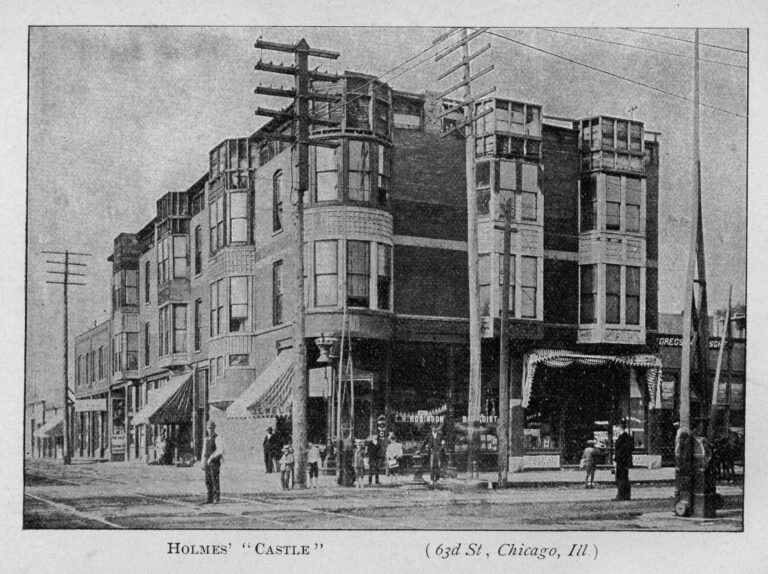
While Geyer was digging in Toronto, the Chicago police were tearing apart Holmes’ building on the corner of 63rd and Wallace in Englewood, which the papers had started calling his “castle.” What they found there, and what was added to the story later, is on the H. H. Holmes Murder Castle Site page.
The Trial and the Confession
Holmes went on trial in Philadelphia on October 28, 1895, for the murder of Benjamin Pitezel. The jury found him “guilty of murder in the first degree,” and he was sentenced to hang. In April 1896, while he waited in Moyamensing Prison, the papers printed his confession. “He Admits of Killing Twenty Seven People,” one headline went. But some of the people on his list were alive. One woman the papers had counted among the castle’s victims, Kate Durkee, “turned out to be very much alive,” as Wikipedia’s account puts it.
He was hanged at Moyamensing on the morning of May 7, 1896. The drop fell at 10:12, one paper reported. He was buried at Holy Cross Cemetery outside Philadelphia. In 2017, a team led by Samantha Cox, a University of Pennsylvania anthropologist, exhumed the grave to answer the History Channel’s questions about who was in it. The body was too far gone for DNA, so they used his teeth. “This was, indeed, Holmes,” WHYY, Philadelphia’s public radio station, reported.
Hauntings & Lore
Holmes has been called America’s first serial killer, and since Erik Larson’s The Devil in the White City became a bestseller in 2003, his story has been told with the 1893 World’s Fair as its backdrop: a doctor who built a hotel for the fair’s visitors, fitted it with vaults, trapdoors, and a crematory, and killed as many as 200 of them. Most of that came later.
Two Hundred Victims
The writer John Bartlow Martin, in Harper’s magazine in 1943, described Holmes’ building as a hotel “ostensibly” built “to accommodate visitors to the great Fair of 1893,” “fitted with operating tables, a crematory, pits containing quicklime and acids.” A ghost tour company’s article says today that “there are some who believe his victims may have numbered as many as 200 or more.”
Adam Selzer, a Chicago author who wrote a book on Holmes in 2017, went back to the records. Holmes added a third floor to his building in 1892 and told people it would be a hotel, Selzer says, “but it was never finished or furnished or open to the public.” There’s “a total of about nine” people “that we can say with some confidence he probably killed,” and all of them, History.com reported, were people he already knew. The 200 began, Selzer told History.com, with “kind of a throwaway line” in a 1940 book, Herbert Asbury’s Gem of the Prairie. “The castle never for one day truly functioned as a hotel,” he writes, “and the actual number of World’s Fair tourists he’s suspected of killing there has remained the same since 1895—a single woman, Nannie Williams.”
Below the Post Office
The building is gone, but its corner isn’t quiet. A post office stands on the site now, and the people who tell Holmes’ story say its basement is where he’s felt. “Many people say the basement of the Post Office that now occupies the Murder Castle site can be very creepy,” Tony Szabelski of Chicago Hauntings, a ghost tour company, told CBS Chicago. Jeff Mudgett, a descendant of Holmes who wrote a book, Bloodstains, about learning what his ancestor had done, went down there. Before he did, the tour company American Ghost Walks reports, post office employees warned him: “Don’t go down there. It’s a terrible, haunted place.” He went anyway. “Before I walked down those steps I was a non believer,” he says. “An hour later, when I came out, my whole foundation had changed. I was a believer.”
To stand on the corner where it happened, visit the H. H. Holmes Murder Castle Site at 63rd and Wallace in Chicago.
Been here?
Tell us what happened.
Related Places
Other
H. H. Holmes Murder Castle Site
In 1895, Chicago police dug human bones out of the cellar of H. H. Holmes' building on this Englewood corner, which the papers called his "castle." A post office stands here now, and its basement is said to be haunted.
Contributors

Sources (10)

Frank P. Geyer, Philadelphia, 1896 (Internet Archive)

loc.gov
The Library of Congress's newspaper archive: the Evening Bulletin (Maysville, Ky.), April 1896, on the confession; The Dalles Daily Chronicle and the Madison Daily Leader, May 1896, on the hanging.

The Master of the Murder Castle
Harper's · John Bartlow Martin, December 1943

Did H.H. Holmes Really Build a 'Murder Castle'?
History.com · Becky Little

The True History of H.H. Holmes
WTTW · Alexandra Silets, May 10, 2017
With an excerpt from Adam Selzer's *H. H. Holmes: The True History of the White City Devil*.

Chicago Hauntings: The Story of H.H. Holmes' Murder Castle
CBS Chicago · Adam Harrington

Chicago's Murder Castle and the Ghosts of Englewood
American Ghost Walks

Wikipedia

