
On This Page
History
Before the spring of 1834, Delphine LaLaurie had been prosecuted twice for cruelty to the people she enslaved, and she had walked away both times. Then a fire broke out at her mansion on Royal Street. She left New Orleans that same day and never lived there again.
The Macarty Daughter
She was born Marie Delphine Macarty on March 19, 1787, when Louisiana was a Spanish colony. Her father, the Chevalier Louis Barthélémy Macarty, belonged to a powerful clan of military officers, planters, merchants, and officials. She grew up on the family plantation downriver, in what is now the Bywater neighborhood.
She was 13 when she began an affair with Ramon López y Ángulo, a 35-year-old widower who had just arrived to be second in command to the Spanish governor. Colonial officials needed the king’s permission to marry local women, and López was too impatient to wait for it. In June 1800, he persuaded the bishop of Louisiana to marry them.
When the news reached King Carlos IV, López lost his post and was sent back to Spain. Eventually, the king pardoned him. He named López Spanish consul to New Orleans, which by then was American. On the way there, the ship carrying López and Delphine met with an accident off the coast of Cuba. A dispatch from Havana dated January 11, 1805, reported that he had died “as a result of the running aground of the ship.” A few days later, in Havana, Delphine gave birth to their only child, a daughter called Borquita.
Madame Blanque
Back in New Orleans, the young widow married Jean Blanque in 1807, and she became Madame Blanque. Blanque was a merchant, lawyer, banker, state legislator, and major slave trader. He was also a close associate of the pirates Jean and Pierre Laffite. In 1814, Blanque delivered a famous letter from Jean Laffite to William Claiborne, the governor of Louisiana. In it, Laffite offered his men to help defend New Orleans against the British.
Delphine and Blanque had four children: Pauline, Laure, Jeanne, and Paulin. When he died in 1815, he left her his massive debts and five young children to raise. An inheritance from her father and her own shrewd business dealings put her back on her feet. In 1819, she asked the parish court to let her free Jean Louis, a man she owned who was over 50. The court granted the petition. By 1825, when she met her third husband, she was a very wealthy woman.
A Doctor 16 Years Younger
Louis LaLaurie came to New Orleans from Bordeaux in February 1825, 22 years old and fresh out of medical school in France. He advertised in a New Orleans paper that he would specialize in “straightening crooked backs,” and letters from his family mention his treatment of a “Mademoiselle Blanque,” probably Delphine’s daughter Pauline. He was 16 years younger than Delphine.
Their son, Jean Louis, was born on August 13, 1827. The couple married five months later, on January 12, 1828. Under a contract signed that day, Delphine kept control of her own property, real estate, and enslaved people, worth $67,000. Louis brought $2,000.
Within a year, the marriage was the talk of at least one letter writer. Jean Boze managed a plantation at Gentilly for its owner, Henri de Ste-Gême, and sent him gossipy newsletters in France. Carolyn Morrow Long, whose biography Madame Lalaurie, Mistress of the Haunted House came out in 2012, quotes them from the Ste-Gême family’s papers. “They do not have a happy household,” Boze wrote, and “they fight, they separate, and then return to each other.”
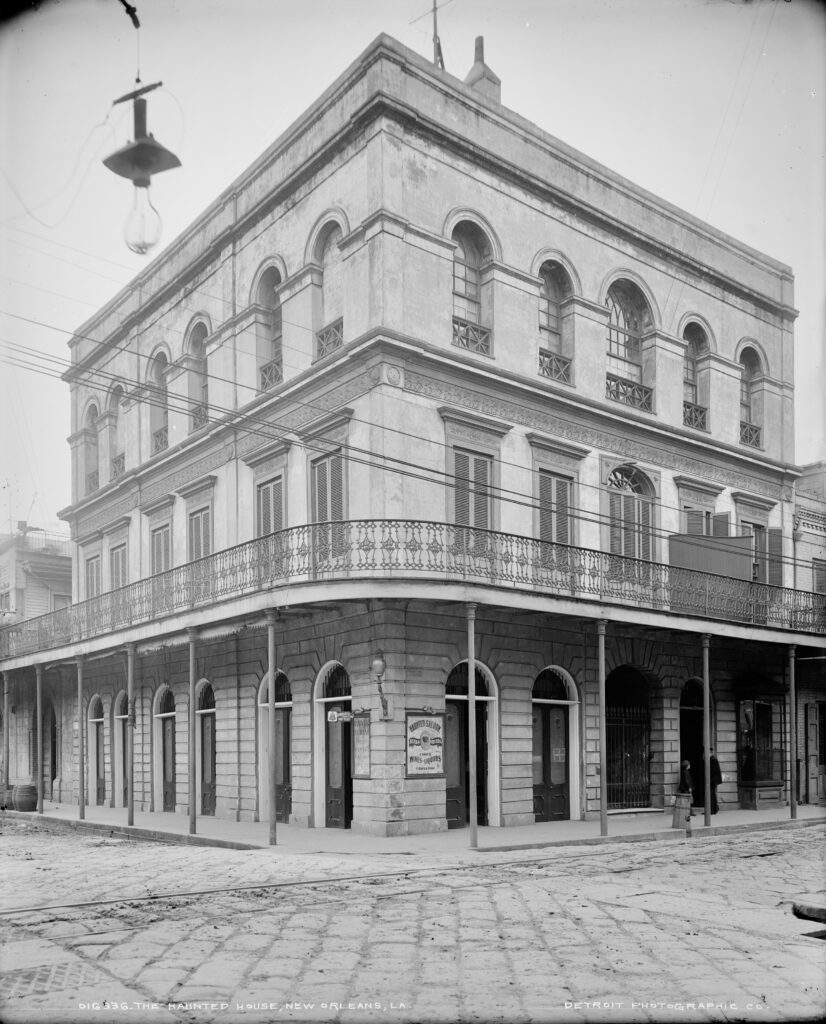
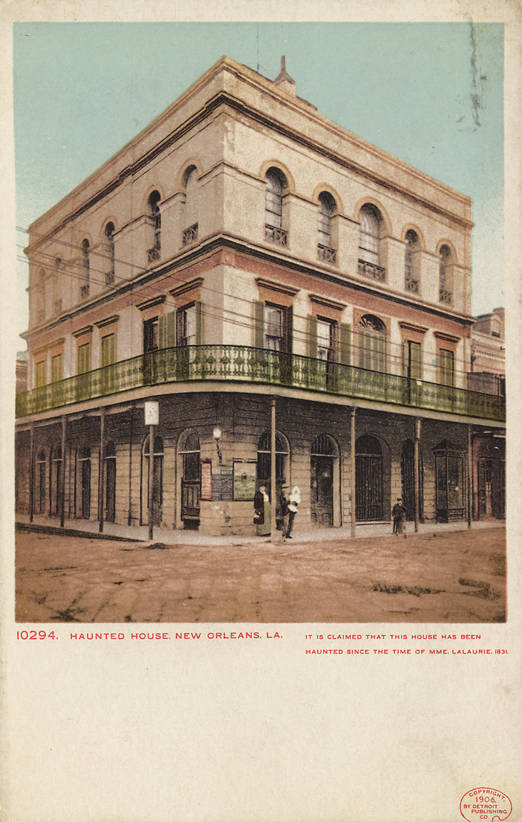
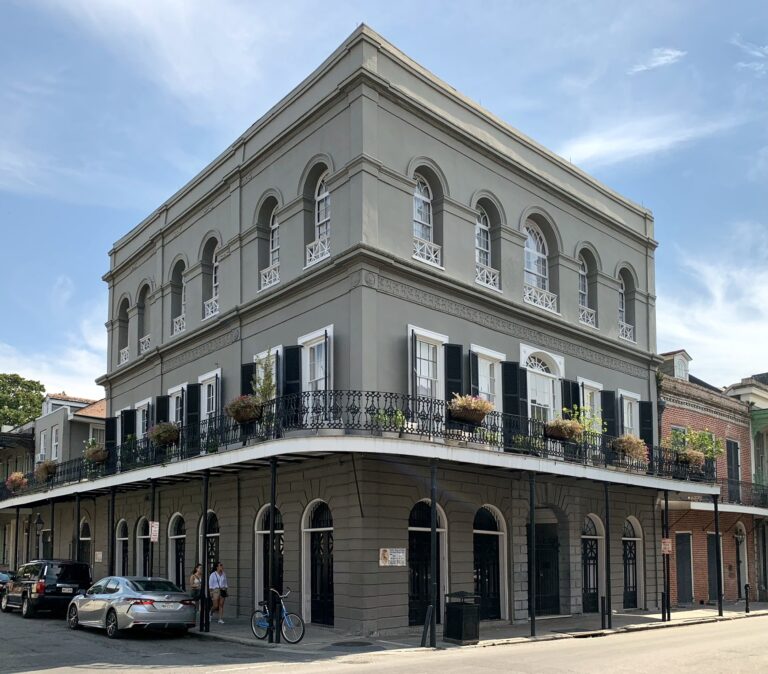
In 1831, Delphine bought an unfinished mansion at the corner of Royal and Hospital (now Governor Nicholls) streets, the site of today’s LaLaurie Mansion. The deed names her “Delphine Macarty de Lopez Blanque Lalaurie,” her own name followed by all three husbands’. The move didn’t mend the marriage. In 1832, she petitioned a court for a separation, testifying that “in the presence of many witnesses he beat and wounded her in the most outrageous and cruel manner.” Louis told a notary that his medical practice kept him in Plaquemines Parish, down the river toward the Gulf, most of the time. That October, she and Louis petitioned together to free a man they owned, Devince, a Louisiana Creole of about 40 or 45. The court granted this petition as well.
Prosecuted Twice, Cleared Twice
Boze’s letters also tracked something worse. In 1828, he wrote that the authorities had gone to her home on reports of “barbarous treatment of her slaves” and had found them “still all bloody.” In 1829, he reported that “an indulgent jury” had found her not guilty. A receipt that is almost certainly from that case survives. John Randolph Grymes, one of the most famous lawyers of the day, signed it on June 22, 1829. It records “three hundred dollars for my fee for defending the prosecution of the State against her in the Criminal Court.” In 1832, Boze wrote that she had been indicted again and had cleared herself “by paying a sum of money.”
The criminal court’s own records for those years are lost. No court file documents any of the charges. Extreme cruelty to enslaved people was against the law, but few owners were convicted of it. The English writer Harriet Martineau, who visited New Orleans in 1836, heard a local reason. Martineau used “creole” for anyone born in Louisiana, and she found its French and American Creoles at odds. She believed no American could expect a verdict “from a jury of French creoles.” Delphine was French Creole, and “Madame Lalaurie enjoyed a long impunity from this circumstance.”
Two people enslaved by Louis LaLaurie died four days apart in November 1833, five months before the fire. The Louisiana State Museum’s cards for St. Louis Cemetery No. 1 name them as Maroya, who was 20, and Sally, and give no cause of death.
The Fire and the Flight
The fire broke out in the kitchen of the Royal Street house on the morning of Thursday, April 10, 1834. Delphine and Louis were both at home that day, despite their legal separation. Inside, rescuers found seven enslaved people in chains. They had been starved and tortured. As a crowd gathered outside, her enslaved coachman Bastien got her out of the city at a gallop, along the Bayou Road to Lake Pontchartrain. The newspapers reported that her “successful escape from the hands of justice” was what turned the crowd on her empty house. That evening, Boze heard “the cries of riot and the fracas.” He wrote to France that she had escaped “the pursuit of justice and the rage of a people who gathered by the thousands.”
A schooner took her across the lake to Mandeville, on its north shore, where she and Louis stayed long enough to put their affairs in order. She was still there 10 days later, according to notarial records the writer George Washington Cable cited in 1889. Before she left, she gave power of attorney to her sons-in-law Placide Forstall and Auguste DeLassus. This time, she made no arrangements to free any of the people she owned, not even Bastien. Of the 30 people she owned when the house burned, Forstall later sold 11, Bastien among them. The archives don’t account for the other 19.
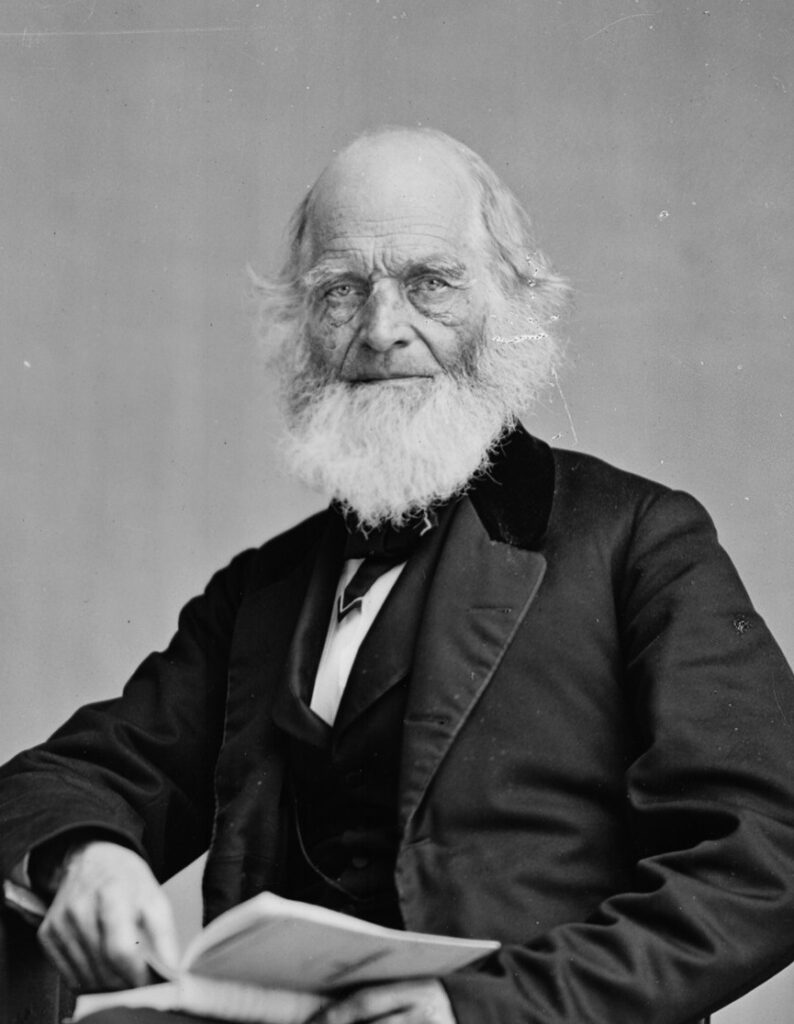
From Mandeville, the LaLauries went on to Mobile and New York. On June 24, 1834, they sailed for Le Havre, France, on the ship Poland. The American poet William Cullen Bryant was on board. He wrote in his journal that she was the lady known to have “committed such horrible cruelties upon her slaves.” She “seemed much affected by the reserve with which the other travelers treated her and was frequently seen in tears.”
Paris
In France, the LaLauries stayed briefly with Louis’s family in Villeneuve-sur-Lot, then moved to Paris. Her grown, unmarried children, Pauline, Laure, and Paulin Blanque, joined her there. Within a few years, Louis left for Cuba. He was never reunited with his wife and son, and he died in Havana in 1863.
Delphine rented rooms at several addresses in the fashionable neighborhood around the Church of la Madeleine and made frequent trips to the spas of the Pyrenees. Her money came from New Orleans, when it came at all. DeLassus, who had taken over her affairs from Forstall, kept it for his own purposes, and she borrowed heavily to keep up a lavish life. In letter after letter, she pressed him for money and an accounting. At last, she resolved to go back and settle things in person.
In 1842, her son Paulin wrote to DeLassus that she meant it. He had “lived with her and studied her” for years, he wrote, and time hadn’t changed “anything in that indomitable nature.” He had come to believe that she “never had any idea concerning the cause of her departure from New Orleans.” She never made the trip.
A Tomb in New Orleans
Delphine died after a long illness at her home on the Rue d’Isly in Paris on December 7, 1849. Her funeral was held the next day at the nearby Church of St. Louis d’Antin, and she was buried for the time being in the Cemetery of Montmartre. In 1851, the caretaker’s records show, her remains were dug up to be shipped to New Orleans.
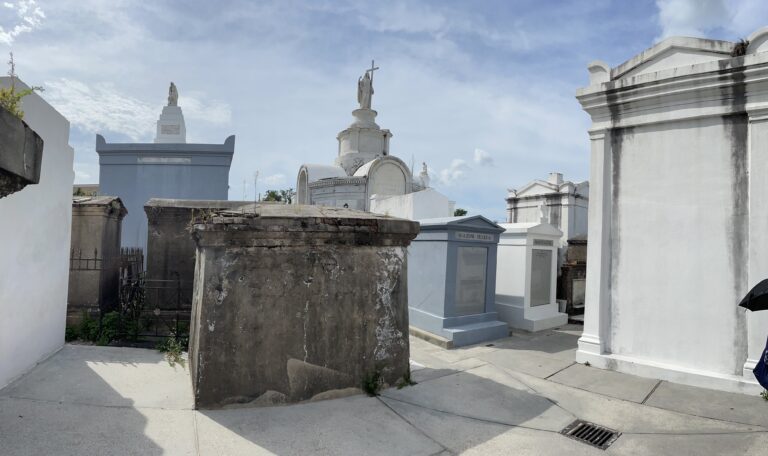
According to the archdiocese’s registers, the tomb in St. Louis Cemetery No. 1 that is said to be hers belonged to Paulin. Long thinks he may have bought it before he had his mother’s body brought home, and that she is probably there, though no one in her immediate family appears in its list of burials.
The fight over her inheritance outlasted her. Her brother, Louis B. Macarty, had left three-quarters of his estate to “his sister, Madame Lalaurie,” and nothing to his nephew and niece. They won in a lower court, which annulled the will. In May 1852, the Louisiana Supreme Court reversed that ruling and threw out their claim against “the heirs of the late M’me. Lalaurie,” the Daily Picayune, a New Orleans paper, reported.
Hauntings & Lore
Delphine LaLaurie’s legend followed her across the Atlantic. Within four years of the fire, it was in print in London, and it has been growing ever since. “Over time the story has been embellished with increasingly gruesome details,” Long writes, “but archival research reveals that at least some of it is true.” The ghost stories belong to the house on Royal Street, and its page tells them.
Run Out of Paris
Martineau first heard the story in the spring of 1836, when the ruined house caught her eye. In her 1838 book, Retrospect of Western Travel, she wrote that Delphine had settled in Paris “under a feigned name, but not for long.” One evening, Martineau heard, a party of gentlemen “told her she was Madame Lalaurie, and that she had better be off.” She fled that night, and she was “supposed to be now skulking about in some French province under a false name.”
Cable repeated it in 1889, in his book Strange True Stories of Louisiana: “Being recognized and confronted there, she again fled.” Henry Castellanos, a New Orleans writer, added in 1895 that a Paris theater audience had once met her with “hissing and hooting.” It was “currently reported in New Orleans circles,” he wrote, that she had since “adopted a strictly pious life.”
The record puts her in Paris for the rest of her life. She had settled there by 1835, and that is where she died.
The Boar at Pau
Cable also passed on a story about her death, told by a domestic servant in a Creole family that had known her. A letter from France, the servant said, told the family that Delphine had joined a party of fashionable people on a boar hunt while staying at Pau, a resort village in the Pyrenees. Meeting the boar away from the others, she was “torn and killed” before anyone could reach her. Cable himself called this part of her story “tradition.” One version of the legend sets the hunt in 1842.
The record puts her death seven years later, in her own home in Paris, after a long illness.
The Charming Hostess
In a 2020 National Geographic feature on the most haunted places in the United States, Gulnaz Khan describes Delphine as “a Louisiana socialite known for hosting ritzy soirees.” Her guests feasted on fine food and champagne, Khan writes, “unaware of the grisly scenes that unfolded two stories above.”
Martineau heard a version of the same thing in 1836. Delphine was “so graceful and accomplished, so charming in her manners and so hospitable, that no one ventured openly to question her perfect goodness.” Martineau was also told about her dinner parties. Delphine would hand what was left in her wineglass to the emaciated man behind her chair and whisper, “Here, my friend, take this; it will do you good.”
The record says New Orleans knew more than that. Rumors of her cruelty had been circulating for years before the fire, and twice they had reached a courtroom. Martineau’s own account has her lawyer friend sending Delphine a warning about the law once “rumours spread.”
Martineau allowed that Delphine might have been insane. Even then, Martineau wrote, “the insanity could have taken such a direction, and perpetrated such deeds nowhere but in a slave country.” Long, writing almost 180 years later, describes eyewitness accounts of “extreme mood swings.” Her conclusion is close to Martineau’s: “Because she lived in early 19th-century New Orleans, she tortured the slaves over whom she had power, and until the day of the fire, she got away with it.”
Kathy Bates as Madame LaLaurie
Television gave her a second life. “In 2014, the infamous murderess was reborn through Kathy Bates in the television series American Horror Story: Coven,” National Geographic’s feature notes.
Been here?
Tell us what happened.
Related Places
Cemetery
St. Louis Cemetery No. 1
Archival records place Voodoo queen Marie Laveau in her family's tomb in St. Louis Cemetery No. 1, the city's oldest. Devotees began bringing her offerings and petitions there almost as soon as she died in 1881.
House
LaLaurie Mansion
On April 10, 1834, a fire at Delphine LaLaurie's Royal Street mansion revealed seven enslaved people who had been starved, tortured, and chained. By 1889, the writer George Washington Cable was calling it "The Haunted House in Royal Street."
Dig Deeper
Investigations

Portals to Hell Crew
LaLaurie Mansion
Jack and Katrina head down to the Big Easy to perform the first-ever paranormal investigation of the infamous LaLaurie Mansion, said to be haunted.
Books
-

Haunted New Orleans
Join supernatural historian Troy Taylor as he takes readers beyond the French Quarter and shows a side of New Orleans never seen. read more
Tours
-
New Orleans Ghosts (US Ghost Adventures)
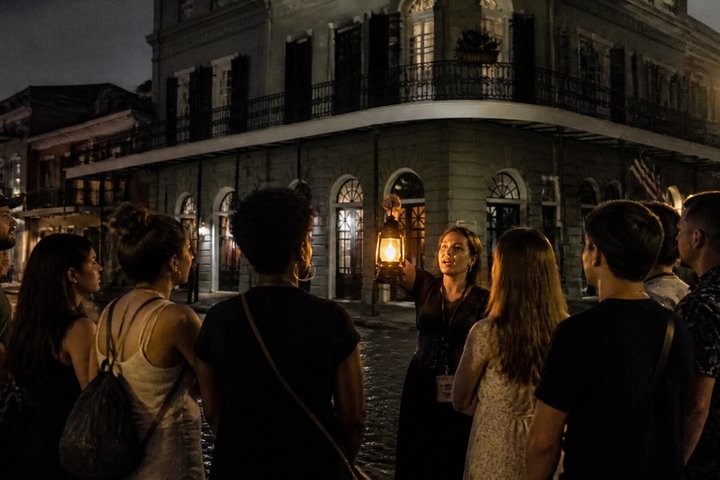
New Orleans Ghosts is the New Orleans brand of US Ghost Adventures, a company that runs ghost tours under local names in… see tour company
-
Ghost City Tours in New Orleans
Ghost City Tours in New Orleans is the local branch of Ghost City Tours, which says it has run ghost tours in… see tour company
Contributors

Sources (8)

Louisiana's online encyclopedia: Carolyn Morrow Long's Mistress of the Haunted House (2016, updated 2020) and Delphine Lalaurie (2016)

The Historic New Orleans Collection, Vieux Carré Digital Survey

Harriet Martineau, Retrospect of Western Travel, vol. 1 (1838); George Washington Cable, Strange True Stories of Louisiana (1889)

Henry C. Castellanos, 1895, via the Internet Archive
America's Historical Newspapers
The Daily Picayune of May 5 and May 28, 1852, on the Macarty succession before the Louisiana Supreme Court

Digital Library on American Slavery, University of North Carolina at Greensboro
The Orleans Parish Court emancipation petitions of July 22, 1819 (Jean Louis) and October 26, 1832 (Devince)

The Louisiana State Museum's cemetery cards for Maroya and Sally, November 1833

These are the most haunted places in the United States
National Geographic · Gulnaz Khan, October 2, 2020