
On This Page
History
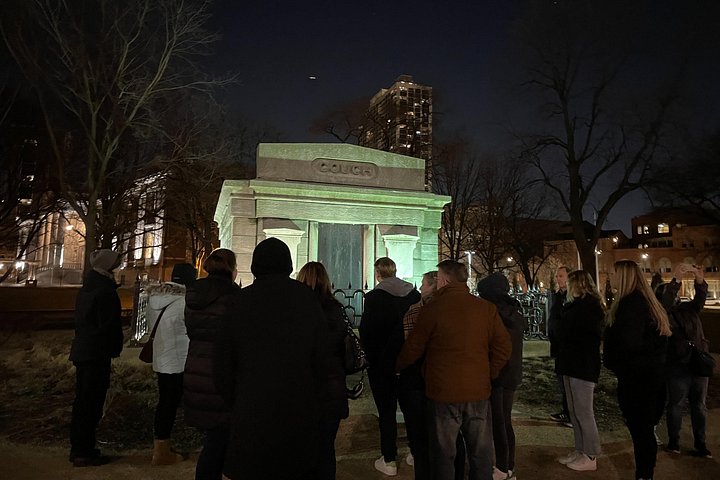
The Couch Tomb, also called the Couch Mausoleum, is all that still stands of Chicago’s City Cemetery. The cemetery lay near the lakefront, at what is now the south end of Lincoln Park. A Chicago doctor, John Rauch, began calling for it to close, fearing that the dead were leaking disease into Lake Michigan. Starting in 1864, the city council ordered burials stopped and the bodies moved to new cemeteries like Graceland and Rosehill, outside the city limits. The ground became part of the park, and families were expected to move their own relatives. Few did, according to Pamela Bannos, a Chicago artist whose Northwestern University project, Hidden Truths, traced what happened to the cemetery. In 1871, the Great Chicago Fire burned through the graveyard and destroyed many of its markers. Counting the City Cemetery and a Catholic one beside it, Bannos estimated that more than 12,000 of the dead may never have been moved. In 2008, the Chicago Reader, a free Chicago newspaper, asked Russell Lewis, chief historian at the Chicago History Museum, whether thousands of bodies were left behind. “A lot of these things are speculation,” he said. He also said that “anytime you do any digging out in the park, it’s not unlikely you’ll find some human bones.”
The tomb was built in 1858 for Ira Couch, who had died the year before. With his brother James, Couch had run the Tremont House, Chicago’s second hotel. The tomb’s architect, John M. Van Osdel, was the city’s first professional architect and had also designed one of the brothers’ hotels. When the cemetery was cleared, the 50-ton tomb stayed, and nobody knows for certain why. The Chicago Park District, which runs Lincoln Park, says it seems likely the family thought the tomb was too expensive to move. Bannos believes no one would take on the cost of removing it. Even who is inside is uncertain. The Park District says Ira Couch and several relatives were placed in the tomb. Bannos found no record of anyone being put there. The two marble tablets beside its door are blank, and they were blank even in the earliest photographs she found.
Hauntings & Lore
The White Ghost at Midnight
Tony Szabelski of Chicago Hauntings, a ghost tour company, told CBS Chicago in 2021 that some of Lincoln Park’s earliest ghost stories centered on the Couch Tomb. In his telling, newspapers were reporting a neighborhood legend about the tomb as early as the 1880s. Come to the tomb at the stroke of midnight, any night of the week, the legend said. Face it, look up at the name Couch, and say three times, “The graves belong to the dead, not the living.” The doors would open. Then “a big white ghost would come out and greet you.” In the same telling, a lot of people reported seeing that big white figure around the tomb in the 1880s, too.
The words of the charm turn up in another tale about the tomb. By the 1930s, the Chicago Tribune was telling readers that a court had ruled the tomb could stay when the graves were moved. In 1941, a search of the court records for the Park District turned up no such case. In 1951, the Tribune passed along a version in which the U.S. Supreme Court had ruled, sometime in the late 1800s, that burial plots “belonged to the dead, not the living.”
Visit
Visiting Couch Tomb
- Official visitor info: Couch Tomb — Chicago Park District
- How to visit: Open to the public: the tomb stands inside a fence in Lincoln Park, behind the Chicago History Museum. Join a guided tour for the deeper history (see Tours That Stop Here).
Location
Couch Tomb, Chicago, IL 60614
Dig Deeper
Tours That Stop Here
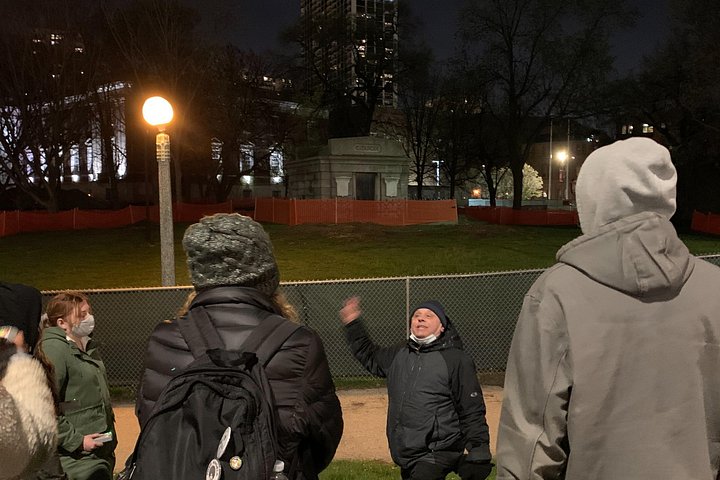
Lincoln Park Hauntings Ghost Investigation Tour
by Chicago Hauntings
135 minFrom $43.99★ 4.9 · 47 reviews
Investigation WalkingA walking ghost hunt through Lincoln Park’s old City Cemetery, where guests learn to use the guides’ ghost-hunting equipment. see tour
Book on ViatorChicago Hauntings Original Ghost Bus Tour
by Chicago Hauntings
3 hrFrom $59★ 3.8 · 154 reviews
TrolleyThe ghost tour for those who’d rather not walk: a narrated night coach tour from the Eastland and Death Alley to Hull-House and Resurrection Mary. see tour
Book on ViatorEmbers of the Windy City: Chilling Chicago Ghost Tours
by Windy City Ghosts (US Ghost Adventures)
1 hrFrom $26★ 4.4 · 129 reviews
WalkingUS Ghost Adventures’ Chicago ghost walk: Lincoln Park’s forgotten burial ground, Dillinger’s Biograph, and the neighborhood’s haunted bars. see tour
Book on Windy City Ghosts

Contributors
Sources (7)

Chicago Park District


Chicago Hauntings: the Couch Mausoleum
CBS Chicago

A Conservatory, a Zoo, and 12,000 Corpses
Chicago Reader · Robert Loerzel, May 15, 2008

What's That Building? The Couch Tomb in Chicago's Lincoln Park
WBEZ · Dennis Rodkin, October 25, 2018

Exploring History Through Chicago's Earliest Cemeteries
Chicago Public Library

Pamela Bannos, Northwestern University, 2008
the Couch Tomb: why it stayed, who may be inside, and the Chicago Tribune's changing accounts of it, 1937 to 1951