
On This Page
History
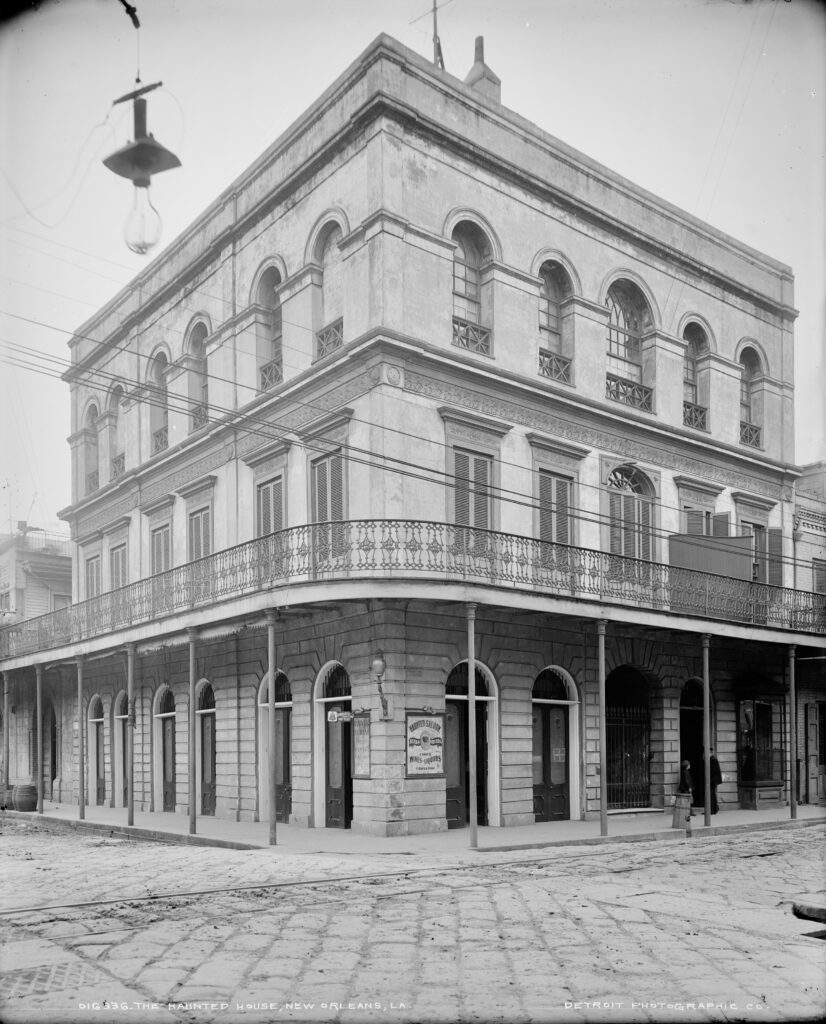
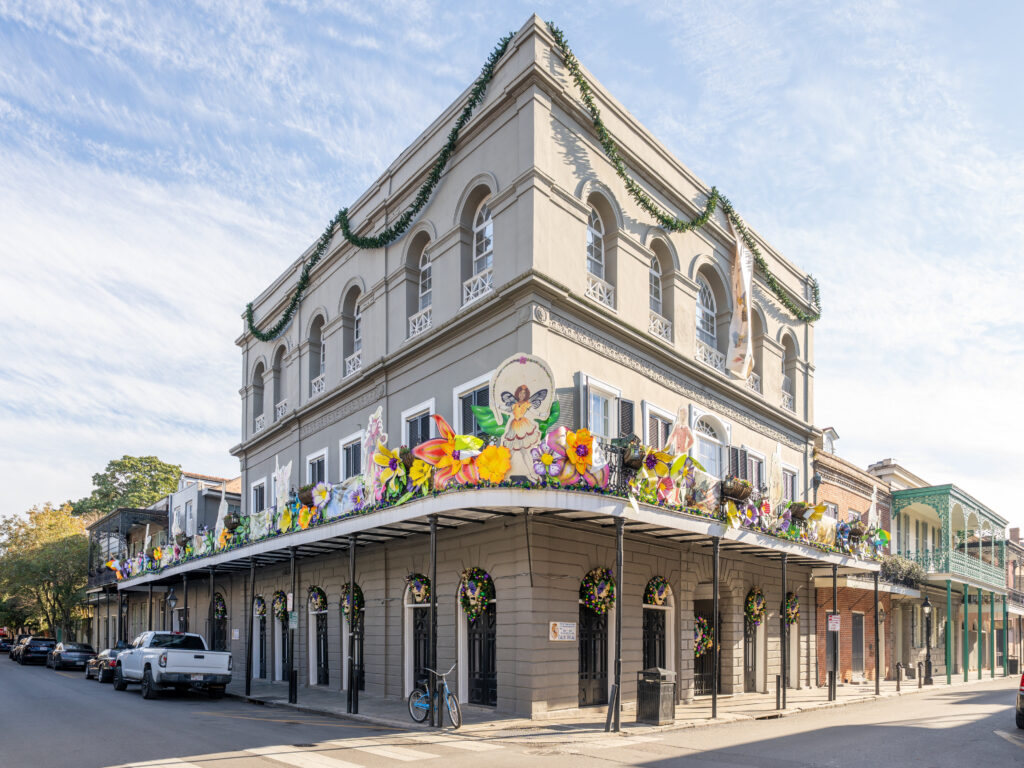
The gray mansion on the corner of Royal and Governor Nicholls streets is not the house where Delphine LaLaurie lived. Hers was wrecked in April 1834, first by fire and then by a crowd of New Orleanians who had seen what the fire exposed. The house that ghost tours stop at today went up on its ruins in 1838, according to the architectural historian Robert Cangelosi.
Delphine LaLaurie’s House
In 1831, Delphine LaLaurie bought two lots at the corner, which was then Royal and Hospital streets. The ground had belonged to the Ursuline nuns, whose Old Ursuline Convent still stands nearby, until they sold it in 1825. The seller in 1831, Edmond Soniat Dufossat, was still finishing a house there. The act of sale, signed on August 30, 1831, says “the principal house and other dependencies” were not yet complete and has him promising to deliver them within 30 days.
Cangelosi describes that first house as two stories, probably of exposed brick, in the Federal style. The historian Tiya Miles gives it an attic as well, in her 2015 book Tales from the Haunted South. A service wing behind the house held the kitchen and the quarters of the people Delphine enslaved. She paid $33,750.
Delphine, born into the powerful Macarty family, was wealthy in her own right. Her third husband, Louis LaLaurie, was a French doctor 16 years younger than she was.
The Fire and the Crowd
On the morning of April 10, 1834, fire broke out in the kitchen. The Courier, a New Orleans paper, reported the same day that some of the neighbors already knew “that the upper part of this building was used as a prison.” Jacques François Canonge, a judge of the criminal court, asked the LaLauries where the enslaved people were kept. Louis LaLaurie told him that “there were those who would be better employed if they would attend to their own affairs instead of officiously intermeddling with the concerns of other people.”
The doors were forced open. Another paper, the Mercantile Advertiser, counted seven people in chains: a woman in the burning kitchen, two in a room on the ground floor, and four “up stairs and in the garret.” One of them, a boy, said he had been chained for five months and fed a handful of meal a day. Another, the Courier reported, was a woman “upwards of 60 years of age, who could not move.” None of the seven was identified by name.
Young men carried the woman who could not move to the city guard house, and the other six were taken there too, “to be protected from the cruelty of their owner.” The Bee, a third New Orleans paper, wrote that they had been “merely kept in existence to prolong their sufferings.” “Four thousand persons at least” came to see them over the next two days, by its count.
As the day went on, a crowd waited outside the house for the sheriff to arrest Delphine. No officer came. Instead, Bastien, the enslaved man who drove her carriage, brought it to the door. She stepped in, and they galloped out the Bayou Road to Lake Pontchartrain, where she boarded a schooner and got away.
That evening, the crowd broke into the empty house. With its report already in type, the Bee added a postscript: “the fury of the mob remained still unabated and threatens the total demolution of the entire edifice.” The crowd smashed furniture, china, and crystal, and it wrecked the floors, stairs, and wainscoting and dismantled the iron balconies. It was still at work on the roof and walls the next morning, when the sheriff came to stop it. “Nearly the whole of the edifice is demolished,” the same paper reported on April 12, “and scarcely any thing remains but the walls,” which the crowd had covered with writing.
Two years later, the English writer Harriet Martineau found the house still standing in ruins. “It was the strange sight of its gaping windows and empty walls, in the midst of a busy street, which excited my wonder,” she wrote in 1838.
Rebuilt on the Ruins
Delphine lived the rest of her life in Paris. Placide Forstall, her son-in-law and agent, sold the ruin in March 1837 for $14,000, less than half what she had paid. The buyer, Pierre Trastour, sold it that July to Charles Caffin. Trastour then built Caffin a new house on the site in 1838, Cangelosi writes, citing a lawsuit. It was a stuccoed house in the Empire style.
An evaluation of the building in the Vieux Carré Survey, The Historic New Orleans Collection’s lot-by-lot record of the French Quarter, puts it plainly. The mansion, it says, “actually is not the same building that the infamous Madame Lalaurie inhabited.” The fire, it adds, probably left little of hers. Caffin kept the new house for 25 years.
Inside the House
When the writer George Washington Cable published the house’s history in 1889, its landlord would not let a photographer inside. Callers were turned away too: more than 300 in one winter, a friend told Cable. Cable described the rooms instead. He wrote of them as Delphine’s, but by the survey’s account, they were the rooms Trastour built.
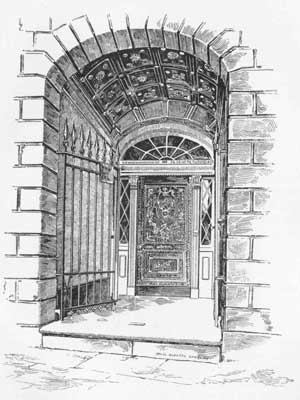
The entrance is on Royal Street, under the balcony. In Cable’s day, iron gates with gilded tops closed off a deep white portal. A few steps rose to a white door covered in raised work: “urns and flowers, birds and fonts, and Phoebus in his chariot.” Inside, an iron-railed stair wound up from a marble floor to the drawing rooms on the balcony level. A deep frieze of “white angels with palm branches and folded wings, stars, and wreaths” ran around the walls, and the windows measured eight feet across.
In the wall of one drawing room, Cable found a little door “barely a woman’s height.” It opened on a small, dark space with “a leap of several feet” to its floor, and he could not make out its purpose.
Behind the main house, a narrow wing four stories high held rows of small square rooms, each with a single high window. Wings like it had once been common in rich New Orleans homes, Cable wrote: “they were the house’s slave quarters.” Some of what he saw there was not common, though: locks seven inches across, and windows with “sturdy iron gratings and solid iron shutters.” In the attic, which was cut up into little closets, he found “all the big iron keys of those big iron locks down-stairs.”
The rear building along Governor Nicholls Street had a single floor until a second was added in the 20th century. In the 1970s, the architects Koch and Wilson redid that second floor’s interior, the survey says.
Schools, a Saloon, and Warrington House
The house became a public high school during Reconstruction, the years after the Civil War. Black and white girls studied there together, and Cable sat in its drawing rooms one June to hear their annual examinations.
In December 1874, the school was raided. On the morning of December 17, a group of 32 pupils from the Central Boys’ High School came to “the Lower Girls’ High School, at the corner of Hospital and Royal streets.” Five of them went from room to room, saying they had come to remove the Black pupils and would use force if the girls refused. The 28 Black girls gathered their things and left, the New-Orleans Times reported the next day.
Cable told it differently in 1889. In his account, a band of men from the White League came up the winding stair. The league was an armed group that meant to take Louisiana’s government by force. “We have come,” their leader told the principal, “to remove the colored pupils.” The Black students were sent out through a crowd in the street, but within a few weeks, they were back.
In 1877, after the state’s Reconstruction government fell, the high school moved out. A high school for Black students opened in the house in its place and lasted “one session, maybe two.” By 1882, the house was a conservatory of music, holding chamber concerts in what Cable called “Madame Lalaurie’s old dining-hall.”
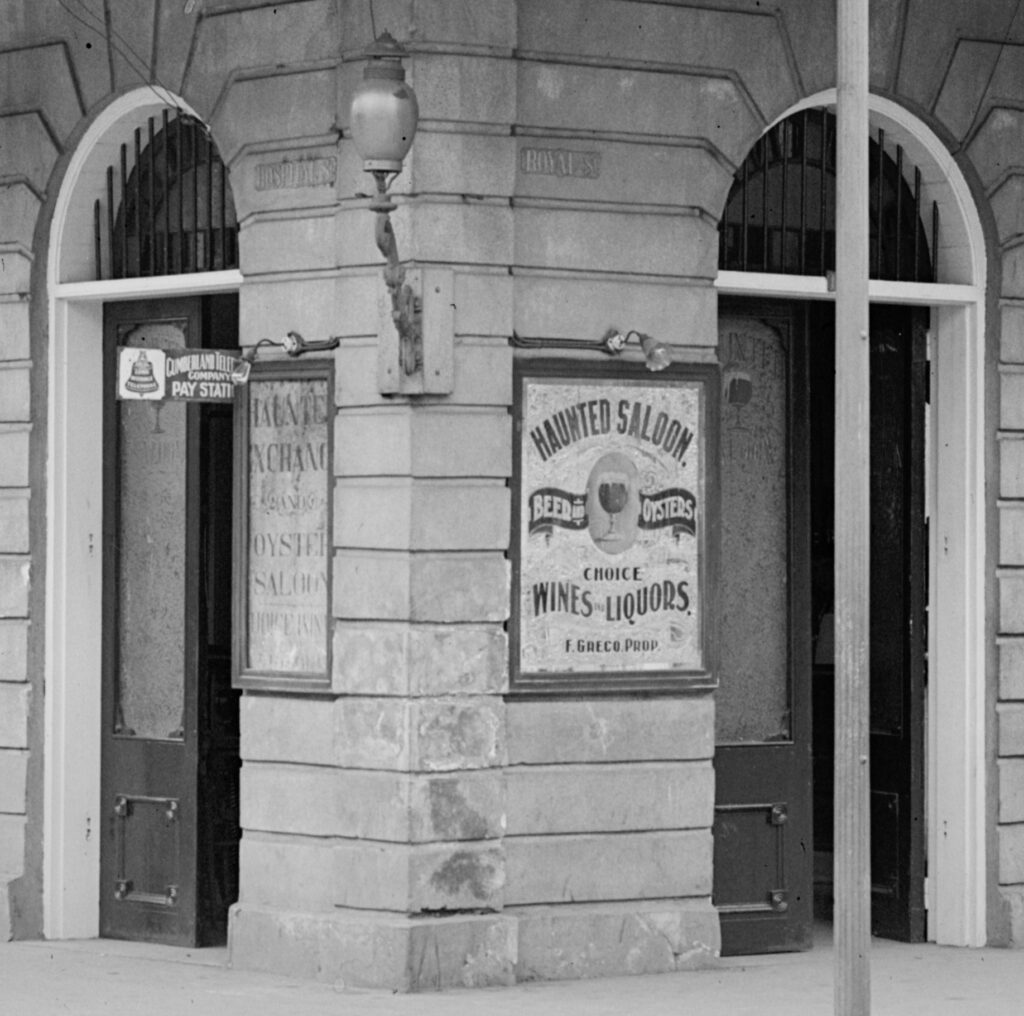
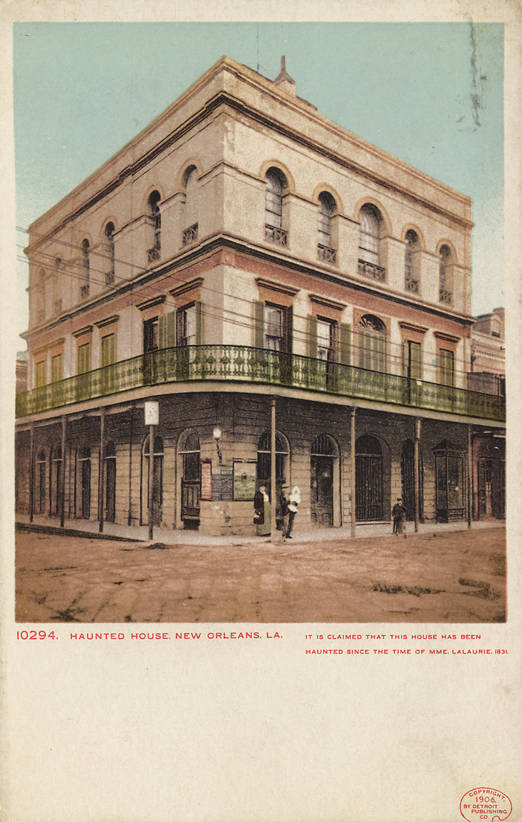
In 1893, Fortunato Greco bought the house. Around 1900, a photograph made for the Detroit Publishing Company caught a saloon on its corner, under signs reading “Haunted Saloon” and “F. Greco Prop.” From 1923 to 1932, the house was run as Warrington House, to help indigent men. Its name was still painted by the corner doors in 1937 or 1938, when Frances Benjamin Johnston photographed the house. The Library of Congress, which holds her pictures in its Carnegie Survey of the Architecture of the South, catalogs them with the note “Haunted House. Now known as Warrington House, social welfare institution.”
A Private Home
Since then, the house has stayed in private hands. The actor Nicolas Cage bought it through a company in the 2000s and lost it to foreclosure in 2009. That November, CNN’s business news site, CNNMoney, reported that Regions Bank had bought it at the foreclosure auction for $2.3 million.
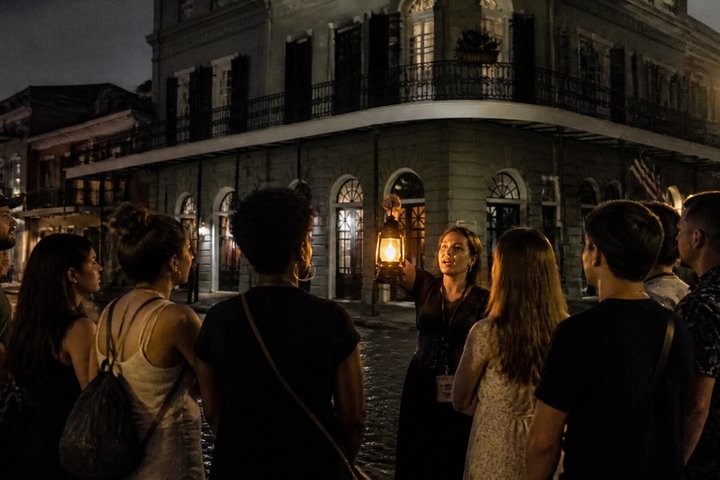
It is still a private home, and it offers no tours. The sidewalk outside is another matter. “Dozens of walking tours converge during the course of each evening” at the house, Frank Perez, a French Quarter resident, tour guide, and Loyola tour-guide instructor, wrote in the French Quarter Journal.
Hauntings & Lore
The writer Lyle Saxon began his account of the house with a disclaimer. “I cannot vouch for the authenticity of the ghosts,” he wrote in Fabulous New Orleans (1928), “but I can give you the facts in the case of Delphine Lalaurie.”
The house stood gutted for at least three years, its walls covered in the crowd’s writing. “So the place came to be looked upon as haunted,” Cable wrote. The story of the girl on the roof, though, is set before the fire.
The Girl on the Roof
Harriet Martineau heard this one in New Orleans and printed it in 1838, saying she had gathered some of it from eyewitnesses. A woman living next door, Martineau wrote, heard “a piercing shriek” and looked out to see a little girl, “apparently about eight years old,” running across the yard. Delphine was behind her, “cowhide in hand.”
The girl ran “from story to story” to the top of the house. The neighbor covered her eyes, but she heard the fall. That night, she watched the body carried out and buried by torchlight in a shallow hole in a corner of the yard.
An inquiry followed, by Martineau’s account, and nine of the people Delphine enslaved were taken from her for illegal cruelty. She had relatives buy them and sell them back to her. Martineau also heard who set the fire: the cook, chained within eight yards of the kitchen fireplace, who said “they had better all be burned together than lead such a life.” In Saxon’s 1928 telling, the cook, “found chained in the kitchen,” admitted she had set the fire because she would rather burn alive than go on living under Delphine’s torture.
When Cable retold the story in 1889, the girl fell “clean to the paved yard below,” and her grave was “a condemned well of slight depth.” But a woman who had worked in the house for years after the Civil War told him that her husband, as a boy, had seen the girl scrambling on the roof, trying to escape. “He did not see the catastrophe that followed,” Cable wrote.
In 1892, the Daily Picayune, a New Orleans paper, reported a ghost on that roof. The people of Royal Street, it said, told of “the figure of a little child” who “may be seen upon moonlight nights haunting the latticed belvedere,” the little lookout on top of the house. That is the earliest telling we found of a child’s ghost there.
None of the 1834 reports we read mentions a girl. Letters from those years do record cruelty. Jean Boze, who managed a plantation and sent news of the city to its owner in France, wrote in 1828 that the authorities had found Delphine’s slaves “still all bloody.” In 1829, he wrote that a jury had found her not guilty. In 1832, he reported that she had cleared a cruelty charge by paying money. Delphine’s biographer, Carolyn Morrow Long, says the court’s own records for those years are lost. Her book, Madame Lalaurie, Mistress of the Haunted House, came out in 2012.
What Was Found Upstairs
Some later tellings put the dead in the attic. A 2020 National Geographic feature on the most haunted places in the United States says police answering the fire “discovered the bodies of several horribly mutilated enslaved people in the attic.”
The papers of 1834 found the seven alive. The Bee’s editor saw them that day. His paper described them this way: “Seven slaves, more or less horribly mutilated, were seen suspended by the neck, with their limbs apparently stretched and torn from one extremity to the other.”
What became of them is disputed. Four days after the fire, another paper, the Louisiana Advertiser, passed on word that two of the rescued had since died. It added that bodies had been dug up in the yard and that more, a child’s among them, had turned up in a condemned well. It offered all of it as hearsay: “We understand,” it said. Martineau had heard that two died that first day, fed too fast.
Henry Castellanos, a New Orleans writer, disagreed with both. In his 1895 book, New Orleans As It Was, he wrote that he had watched the LaLauries’ carriage speed away. The papers of the day, he said, reported the crowd digging up “the whole yard” and finding nothing. Of the rescued, he wrote, “None of them, however, died from surfeit, as it has been erroneously alleged.”
Cable added a find of his own. During the school years, he wrote, a deep hidden well “that no one had suspected the existence of was found in the basement of the main house.”
The record has a gap of its own. Delphine owned 30 enslaved people at the time of the fire, and her agent later sold 11 of them, Bastien among them. The other 19 are unaccounted for in the archival record, Long writes. “At least some of these missing individuals could be Madame Lalaurie’s victims,” she adds. Over time, in her words, the story “has been embellished with increasingly gruesome details, but archival research reveals that at least some of it is true.”
The Haunted House on Royal Street
By the 1880s, the name had stuck. An 1885 guide to the city captioned its engraving of the street “Haunted House Royal St.” Cable called his 1889 history “The ‘Haunted House’ in Royal Street.” On March 13, 1892, the Picayune ran a long history of the house under the headline “The Haunted House.”
Cable had heard the house’s stories, and he retold some of them. Stand in the drawing room, he wrote, and a door’s lock “gives a whispered click and the door slowly swings open.” He called it “an old trick of those doors,” though he allowed that “any carpenter could explain it.” At the girls’ school, the great doors sometimes swung open “untouched by visible hands” in the middle of a quarrel. Then, Cable wrote, “the hushed girls would call to mind Madame Lalaurie.”
A girl from the neighborhood told him she once saw “the figure of a woman leaning against” the lattice of the belvedere on a moonlit night. She looked hard and decided it was “only a sorcery of moonbeams.”
The Picayune’s history also set down what Royal Street said about the house. Everyone on the street, the paper wrote, said “in guarded whispers” that the house was haunted. Residents told of “the strange, unearthly noises that proceed from the damp dungeon and attic” and of lights that “flit rapidly from window to window.” They told, too, of “the long, ghostly procession that winds up the stairway at midnight, and peers cautiously over the roof.” Few in the neighborhood, the paper added, “care to pass the place after nightfall.”
Around 1900, the saloon on the corner called itself the Haunted Saloon. A postcard the Detroit Publishing Company published in the same decade spelled the claim out: “It is claimed that this house has been haunted since the time of Mme. Lalaurie, 1831.” And in National Geographic’s 2020 account, soon after she fled, “people claimed to hear the phantom screams of her victims spilling from the house in the dead of night.”
Fainting in Front of the House
Andrew Ward, a guide for Haunted History Tours, called it the most haunted building in the city. Of the 39 people who had fainted on his tours by 2013, 38 went down in front of this house, he told Tulane University’s news office that year. “So many horrible things were done to people on those premises that it has this lingering negativity, and that has an effect on people around it,” he said.
The tour groups stay on the sidewalk. In 2019, a television crew went inside. The Travel Channel series *Portals to Hell* brought its two hosts in for what the episode’s summary calls “the first-ever paranormal investigation of the LaLaurie Mansion,” with “voodoo rituals and spirit boards.”
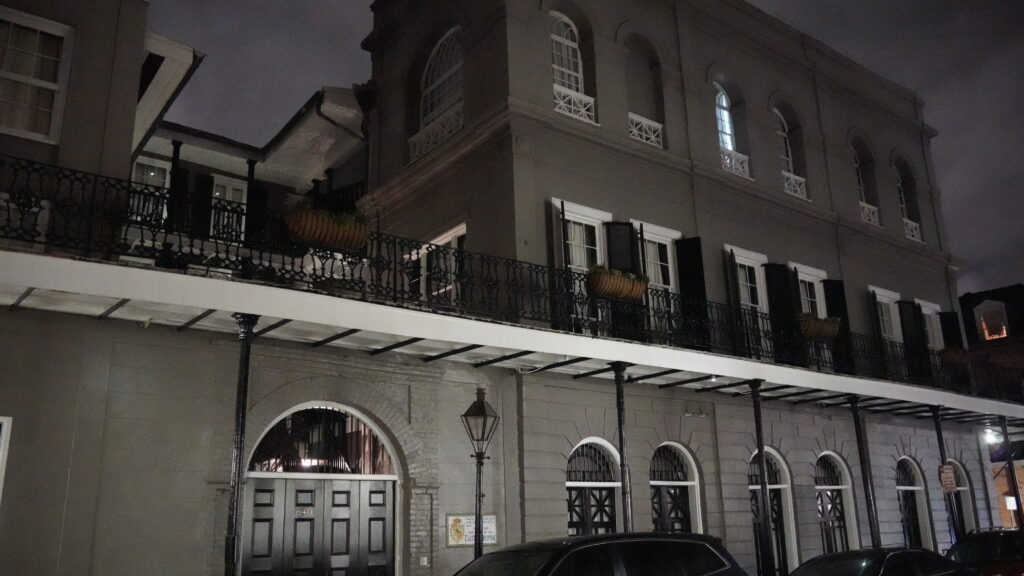
To hear the story on the corner where it happened, join one of the ghost tours that stop outside (see Tours That Stop Here).
Visit
Visiting LaLaurie Mansion
- How to visit: Exterior only. The house is a private residence: see it from the Royal Street sidewalk, and please don’t trespass. Ghost tours stop outside to tell its story (see Tours That Stop Here).
- Finding the story sites: The entrance is under the balcony on Royal Street. Governor Nicholls Street was called Hospital Street in 1834, so the old reports put the house at Royal and Hospital.
- Worth knowing: The building on the corner is not the one where Delphine LaLaurie lived. Hers was wrecked in 1834, and this one was built on its ruins in 1838.
Location
1140 Royal St, New Orleans, LA 70116
Been here?
Tell us what happened.
Related People
-

Marie Delphine MacCarthy LaLaurie
Delphine LaLaurie’s biographer calls her the “Mistress of the Haunted House.” In April 1834, after a fire exposed the enslaved people she… read more
Dig Deeper
On TV
1 episode- Portals to HellLaLaurie Mansion Episode page2019
Books About Here
-

Haunted New Orleans
Join supernatural historian Troy Taylor as he takes readers beyond the French Quarter and shows a side of New Orleans never seen. read more
Tours That Stop Here
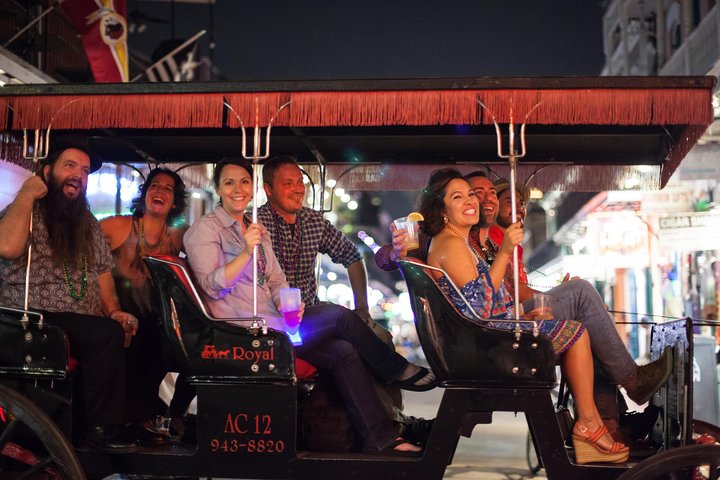
New Orleans Small-Group Haunted History Carriage Tour
by Royal Carriages
1 hrFrom $65★ 4.6 · 2,671 reviews
VehicleA small-group, mule-drawn carriage ride past the French Quarter’s haunted hotels and houses. see tour
Book on ViatorNew Orleans Haunted Ghost Tour: Explore The Paranormal
by NOLA GhostRiders
2 hrFrom $15★ 4.3 · 29 reviews
WalkingAnother NOLA GhostRiders walk into the French Quarter’s darker history. see tour
Book on ViatorHaunted Ghost and Paranormal Tour in New Orleans
by NOLA GhostRiders
2 hrFrom $15★ 4.5 · 100 reviews
WalkingA French Quarter walk into the darker history behind the neighborhood’s colorful face. see tour
Book on ViatorNew Orleans Combo Tour: Voodoo, Vampire, and Ghost Tour
by New Orleans Ghost Adventures
1.5 hrFrom $32★ 4.5 · 408 reviews
WalkingGhosts, vampires, witches, and Voodoo priestesses in one French Quarter walk with a local guide. see tour
Book on ViatorNew Orleans Ghost Tour: Go Inside a Haunted Location
by New Orleans Ghost Adventures
2 hrFrom $37★ 4.6 · 1,346 reviews
WalkingA French Quarter ghost walk that goes inside a private haunted location. see tour
Book on ViatorGhost and Vampire Walking Tour Of The French Quarter
by French Quarter Phantoms
2 hrFrom $21★ 4.7 · 2,567 reviews
WalkingFrench Quarter ghost stories and the city’s real-life vampire scene, with a stop at the LaLaurie Mansion. see tour
Book on ViatorNew Orleans Premier Ghost, Voodoo and Vampire Walking Tour
by Witches Brew Tours
105 minFrom $37.99★ 4.6 · 14,008 reviews
WalkingWitches Brew’s main French Quarter walk past haunted mansions, Creole cottages, and Voodoo sites, with family-friendly options. see tour
Book on ViatorNew Orleans Adults-Only Ghost, Voodoo and Vampire Tour
by Witches Brew Tours
1.5 hrFrom $37.99★ 4.8 · 3,633 reviews
Adults Only (21+) WalkingA 21-and-over outdoor walk through New Orleans’ most sinister figures, with elixirs and offerings along the way. see tour
Book on ViatorNew Orleans Haunted History Ghost Tour
by Haunted History Tours
2 hrFrom $30★ 4.6 · 2,334 reviews
WalkingThe company’s French Quarter ghost walk, with a stop inside a haunted bar. see tour
Book on ViatorPub Crawl: New Orleans Ghosts, Boos, and Booze
by New Orleans Ghosts (US Ghost Adventures)
105 minFrom $29★ 4.8 · 18 reviews
Pub Crawl WalkingA haunted pub crawl to four New Orleans bars, with ghost stories at the stops in between. see tour
Book on New Orleans GhostsFrench Quarter Ghosts and Ghouls of New Orleans
by New Orleans Ghosts (US Ghost Adventures)
1 hrFrom $26★ 4.8 · 190 reviews
WalkingA walk through the French Quarter past Jackson Square, the Old Ursuline Convent, the Beauregard-Keyes House, and the LaLaurie Mansion, with a local storyteller. see tour
Book on New Orleans Ghosts

Contributors

Sources (11)

Louisiana's online encyclopedia: Carolyn Morrow Long's Delphine Lalaurie and Mistress of the Haunted House

The Historic New Orleans Collection, Vieux Carré Digital Survey

What really happened at the Lalaurie House?
Preservation in Print, Preservation Resource Center of New Orleans · Robert J. Cangelosi Jr., November 2019

George Washington Cable, Strange True Stories of Louisiana (1889); Harriet Martineau, Retrospect of Western Travel, vol. 1 (1838)

The Philadelphia Album and Ladies' Literary Port Folio of May 3, 1834, reprinting the New Orleans Bee and Judge Canonge's sworn statement; Henry C. Castellanos, New Orleans As It Was (1895); Lyle Saxon, Fabulous New Orleans (1928); Tiya Miles, Tales from the Haunted South (2015); and, in its Wayback Machine, CNNMoney's "Nicolas Cage: Movie star, foreclosure victim" (Hibah Yousuf, November 13, 2009)
America's Historical Newspapers
The Salem Gazette of May 2, 1834 (reprinting the New Orleans Courier of April 10 and the Bee of April 11), the New-Bedford Mercury of May 2, 1834 (reprinting the Mercantile Advertiser and the Bee), and the Newport Mercury of May 3, 1834 (reprinting the Louisiana Advertiser of April 14); the New-Orleans Times of December 18, 1874; the Daily Picayune of March 13, 1892

Frances Benjamin Johnston's photographs of 1140 Royal St. (1937 or 1938) and their catalog note; the Detroit Publishing Company's The Haunted House, New Orleans, La. (about 1900)

These are the most haunted places in the United States
National Geographic · Gulnaz Khan, October 2, 2020

French Quarter Walking Tours: the city reconsiders guidelines for guides
French Quarter Journal · Frank Perez

The most paranormally active city in America
Tulane News · Ryan Rivet, 2013

Portals to Hell, "LaLaurie Mansion"
TVmaze (season 1, episode 7, June 7, 2019)