
On This Page
History
David Bradford came to Louisiana on the run. A wealthy judge and businessman from Washington County, Pennsylvania, he had been a leader of the Whiskey Rebellion of 1794, a revolt against a tax on whiskey. When the rebellion collapsed, he fled the federal army. In 1796, he arrived by boat at Bayou Sara, near what is now St. Francisville, in what was then Spanish West Florida. The next year, he obtained a Spanish land grant of about 650 acres. The oldest part of the Myrtles, the western half of the house, dates from his time. The National Register of Historic Places puts it at 1796.
Bradford died in 1808. In 1817, his daughter Sarah Mathilda married Clark Woodruff, a lawyer who had trained under her father. The couple spent their honeymoon as Andrew Jackson’s guests at the Hermitage, his home in Tennessee. Woodruff ran the plantation for his widowed mother-in-law and planted about 650 acres of indigo and cotton. The family held enslaved people there. When Woodruff sold the plantation to Ruffin Grey Stirling in 1834, the Stirlings took over the house, the land, and the enslaved people with it. By then, Woodruff’s wife and two of their three children had died, and he had left the plantation to a caretaker.
Stirling came from a wealthy family that owned several great plantations. He renamed the place The Myrtles, for the crape myrtles around the house, and in the mid-1800s, he nearly doubled it. The addition brought a 16-foot-wide entrance and stair hall and the cast-iron galleries, among them the front gallery, 107 feet long. Most of the rooms have plaster ceiling medallions, no two alike. Stirling died in 1854. His widow, Mary Cobb Stirling, kept the family’s plantations going. After the Civil War, she hired her son-in-law William Winter to help run them. She gave Winter and his wife the Myrtles as their home.
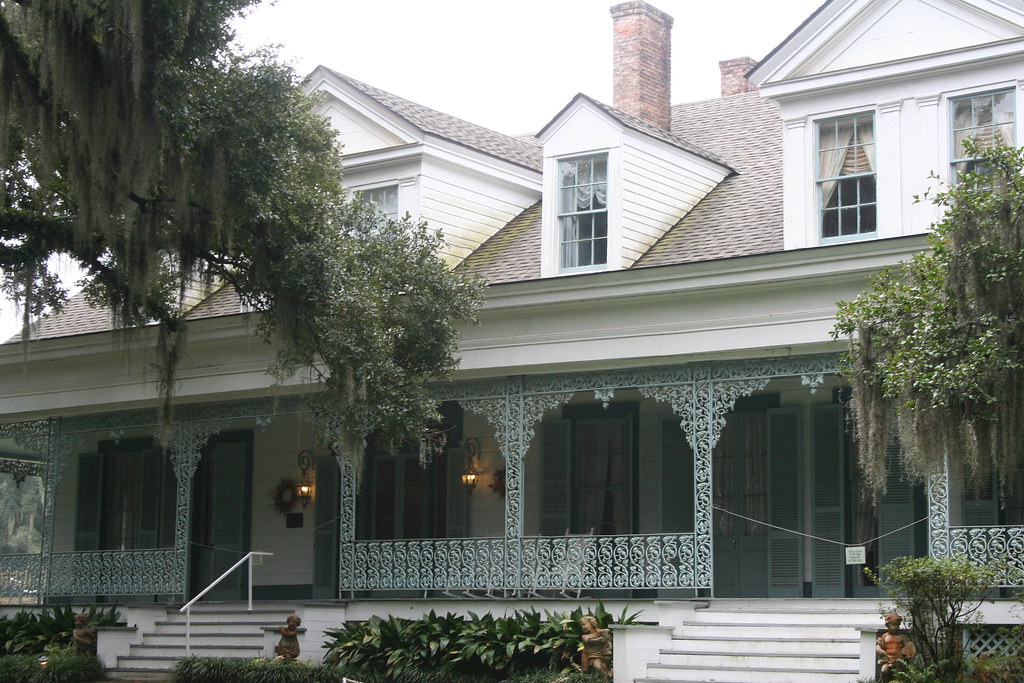
By the 1890s, the Stirlings had sold the Myrtles, and as the 20th century went on, the house fell into disrepair. It was restored in the 1970s and listed on the National Register in 1978. In the 1980s, its new owners, James and Frances Kermeen Myers, made it a bed and breakfast. The Moss family bought it in 1992. Their son, Morgan Moss, and his wife, Lizzie, now own and run it, with 21 guest rooms and a restaurant.
Hauntings & Lore
The plantation bills itself as one of America’s most haunted homes, and not every guest stays the night. “About once a month, someone leaves,” John Moss, who owned it then, told the Austin American-Statesman in 2016. A National Park Service guide to the region’s historic places put the reputation down to “a Reconstruction-era murder and other more natural deaths that have entered into local folklore over the years.” Stories told about the house have claimed 10 murders there. Historians have documented one: William Winter’s, in 1871.
Chloe
“The most popular ghost to haunt the Myrtles is Chloe,” National Geographic’s travel blog wrote in 2008. In its telling, Chloe was a household servant enslaved by the plantation’s owner. Judge Clark Woodruff “had an affair” with her, the blog said. When he began an affair with another girl, Chloe feared she would be put out of the house to work in the fields. To keep her place in the house, she baked a cake with crushed oleander leaves in it, hoping to make his daughters sick so she could nurse them back to health. The poison killed the children. That night, afraid they would be blamed, the other enslaved people on the plantation dragged Chloe from her bed, hanged her, and threw her body in the river.
Troy Taylor, who writes about haunted places, set down a fuller version, “as it has long been told by owners and guides at the house.” In it, Woodruff caught Chloe eavesdropping on his family and ordered one of her ears cut off, and from then on, she wore a green turban to hide the scar. Her cake killed Woodruff’s wife, Sarah Mathilda, as well as the two children. Since then, the story goes, Chloe has often been seen in her green turban, wandering the house at night.
What the Record Says
Taylor told the legend in order to test it against the record, working with David Wiseheart, a researcher who spent countless hours on the plantation’s history. In the Woodruff family’s property records, Wiseheart found no enslaved person named Chloe, or Cleo, as some versions call her. Sarah Mathilda Woodruff died of yellow fever on July 21, 1823, in one of the epidemics that swept Louisiana in those years. Her son, James, died of it on July 15, 1824, and her daughter Cornelia Gale two months later. Their sister, Octavia, grew up, married, and lived to old age. The Myrtles’ own timeline now names yellow fever as the likely cause, too.
Joe Nickell, who investigates paranormal claims for Skeptical Inquirer magazine, spent a night alone in the house in 2001 for a Discovery Channel documentary. He reported in 2003 that the court archives in St. Francisville “fail to substantiate the existence of ‘Chloe.’” The story, he concluded, was “not the product of folklore but of fakelore.”
How the Story Grew
Taylor traced the legend back to a family story. Harrison Milton Williams bought the Myrtles in 1889. According to his granddaughter Lucile Lawrason, her aunts used to talk about the ghost of an old woman in a green bonnet. They often laughed about it, and the ghost was never given a name. In the 1950s, someone told the story to Marjorie Munson, an Oklahoma widow made wealthy by chicken farms, who had bought the house. She wrote a song about the ghost of the Myrtles, a woman in a green beret. The Myrtles’ own timeline dates the song, “Peer Through a Silver Keyhole,” to 1956.
In the 1970s, while new owners restored the house, the story grew to include the poisonings and the severed ear. Frances Kermeen, who owned the Myrtles in the 1980s, wrote her own version. It never named Chloe, Nickell found, and it left out the ear and the turban, though it kept the poisoning.
The Photograph
In 1992, the year the Moss family bought the Myrtles, Mrs. Moss took the photograph the house still calls “the iconic photo” of Chloe. As the Myrtles’ website once told it, the insurance company wanted pictures showing the distances between the buildings. One of them showed what appeared to be an enslaved girl standing between the General’s Store and the Butler’s Pantry. It became the “Chloe postcard.”
When Nickell visited in 2001, Teeta Moss showed him enlargements of photographs of the house. The original negatives were unavailable, he wrote, and one enlargement turned out to have been copied from the printed postcard. Taylor thought the figure looked less like a young woman than like the older woman of the Williams family’s story.
A Historian on the Tour
Tiya Miles, a scholar of American slavery, was then a professor at the University of Michigan. She heard Chloe’s story firsthand on a haunted house tour. In a 2015 essay on ghost tours in the South, she wrote that it drew “good-natured shouts of her (now famous) name” and “knowing, nervous laughter.” Tours like it, she wrote, cast the ghosts of enslaved women as their owners’ “mistresses,” “implying desire and consent in a broader historical context of sexual coercion.”
William Winter and the 17th Step
The Myrtles’ other famous ghost story ends on the stairs. Pam LeBlanc, who wrote the Statesman’s story and stayed the night in the main house, told it this way. A rider approached the house and called out William Winter’s name. When Winter stepped outside, he was shot. He staggered back indoors, crawled to the 17th step of the main staircase, and died in his wife’s arms. “Guests say they still hear his footsteps,” she wrote. The hotel’s own page for its largest suite says Winter died on that staircase “in 1871 on the seventeenth step.”
The record Taylor and Wiseheart cite is a report in the Point Coupee Democrat, a Louisiana newspaper, from January 1871. Winter was teaching a Sunday school lesson in the gentlemen’s parlor when he heard a rider approach. The stranger called out that he had some business with him. Winter went out onto the side gallery and was shot. He collapsed onto the porch and died. It was January 26, 1871, and he was buried at Grace Church the next day. The paper reported that a man named E.S. Webber was to stand trial for the murder, but no outcome was ever recorded. “His bloody trip through the house never took place,” Taylor wrote.
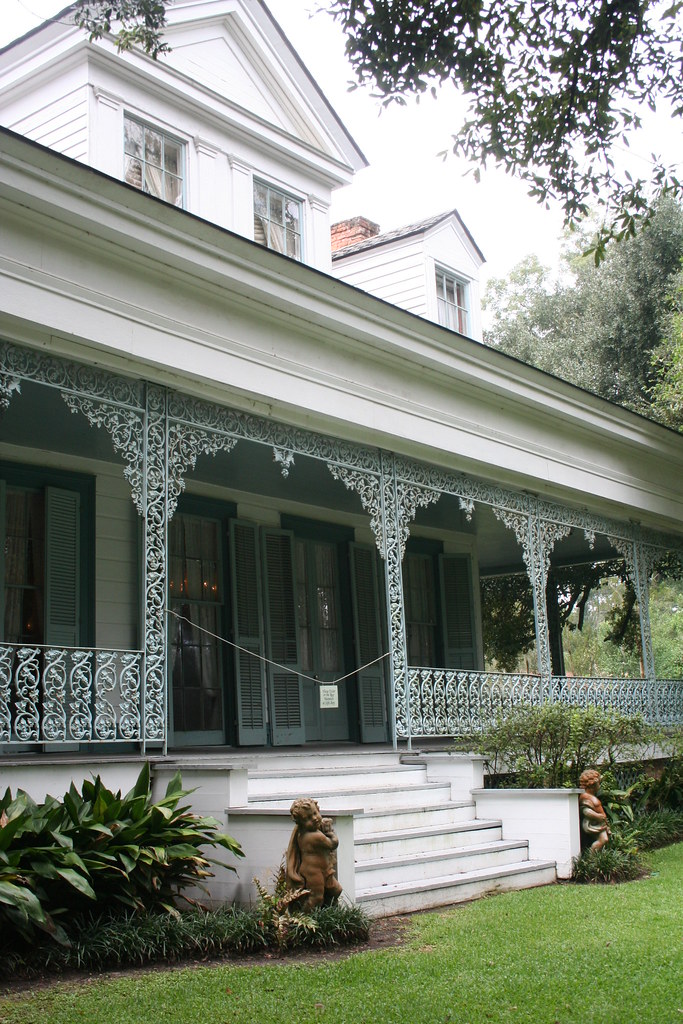
Ask for the Judge Clarke Woodruff Suite, the hotel’s largest, on the second floor of the main house. Its private sitting area is near the staircase of the 17th-step story. The hotel lists the suite by name on its rooms page.
The Mirror
A mirror in a gilded frame dominates the front hall. In the story guides tell, it holds the dead. Hester Eby, a longtime guide at the house, explained it to the writer Barbara Sillery for her 2001 book, The Haunting of Louisiana. In her telling, mirrors were covered with black cloth after a death, or the spirits of the dead could be trapped inside. During the poisoning in Chloe’s story, there was so much confusion that this one was left uncovered. “It’s believed those people’s souls still live inside this section of the mirror,” Eby said. Visitors who photograph it often find handprints in the picture, the story goes, seemingly inside the glass.
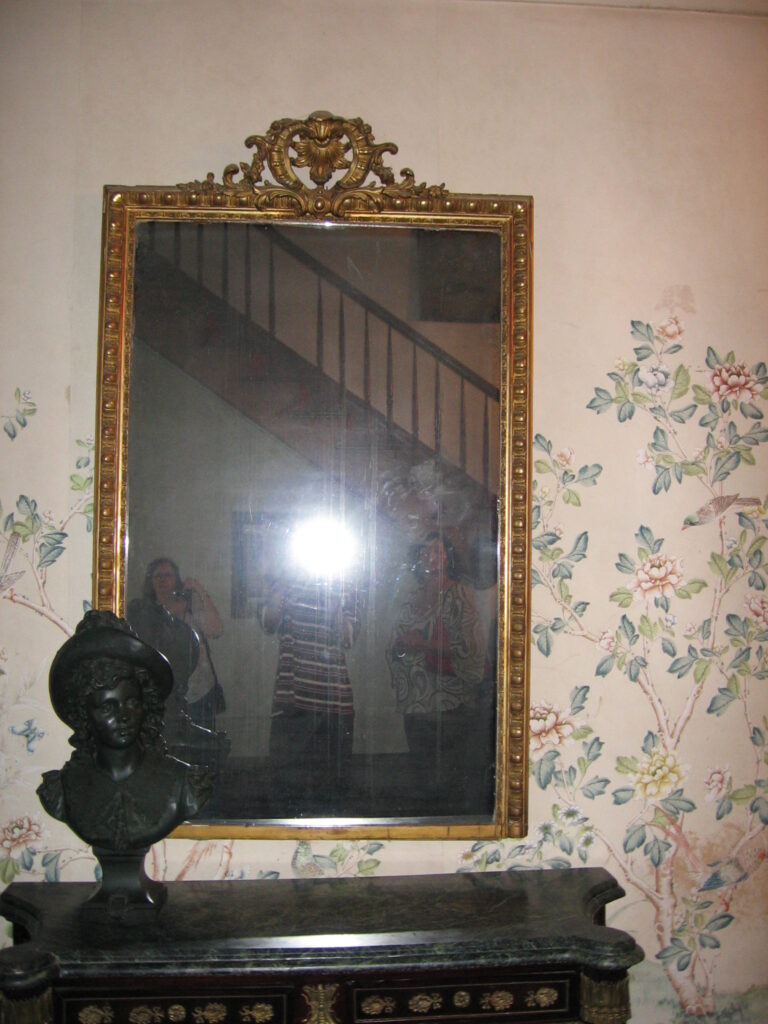
Morgan Moss, who runs the Myrtles now, has been on the property since he was eight months old. In 2023, he told a Baton Rouge lifestyle magazine that his parents tried twice to replace the glass while he was growing up. Both times, the same smear lines and handprints came back.
Nickell took a closer look in 2001. Examining the mirror’s discolored silvering with a lighted magnifier, he found the ridges of human skin and identified one fingerprint as a “plain whorl.” The handprints, he noted, run along the outer edges of the mirror, “consistent with where the glass would have been handled by workmen.”
Visit
Visiting The Myrtles Plantation
Ask for the Judge Clarke Woodruff Suite, because its private sitting area is near the staircase of the 17th-step story.
- How to visit: Open to the public: the grounds are open every day. Tours: the Myrtles runs its own day tours of the six downstairs rooms of the main house, and Evening Mystery Tours of its folklore and ghost stories, sold on its tours page. Patrons: stay the night in the main house. The Judge Clarke Woodruff Suite and the William Winter Room are listed by name on the hotel’s rooms page, and every stay includes a daytime tour of the house.
- Finding the story sites: The mirror hangs in the front hall of the main house, and the staircase of the 17th-step story rises from the central hall. William Winter was shot on the side gallery.
- Worth knowing: The building known as the plantation’s “slave shack,” where Ghost Hunters filmed in 2005, is a recent structure that never held an enslaved person, Joe Nickell wrote.
Book through our links and Spookt gets a small cut, at no extra cost to you. It keeps the research going. How that works
Location
7747 US-61, St Francisville, LA 70775
Been here?
Tell us what happened.
Contributors
Sources (9)

The Myrtles' National Register of Historic Places nomination (Jonathan Fricker, Louisiana Division of Historic Preservation, 1977; listed 1978), on NPGallery, and the Myrtles page of the Park Service's travel itinerary for southeastern Louisiana.

The house's history timeline and its rooms and tours pages, and two pages from its earlier websites: "The Legend of Chloe" and the Judge Clarke Woodruff Suite.

The Legends, Lore & Lies of the Myrtles Plantation
Prairie Ghosts · Troy Taylor and David Wiseheart, 2013

Joe Nickell's "Haunted Plantation" (September–October 2003) and "Scientific Investigation vs. Ghost Hunters."

UNC Press Blog · Tiya Miles, October 30, 2015

Myrtles Plantation: The South's Spookiest House
National Geographic, Intelligent Travel, October 31, 2008

Walk among the ghosts at the Myrtles, a haunted Louisiana plantation
Austin American-Statesman · Pam LeBlanc, September 4, 2016

Get a glimpse into the design of The Myrtles
inRegister, October 19, 2023

The episode lists for *Ghost Hunters* and *Ghost Adventures*.