
On This Page
History
A New Cemetery Outside the Old City
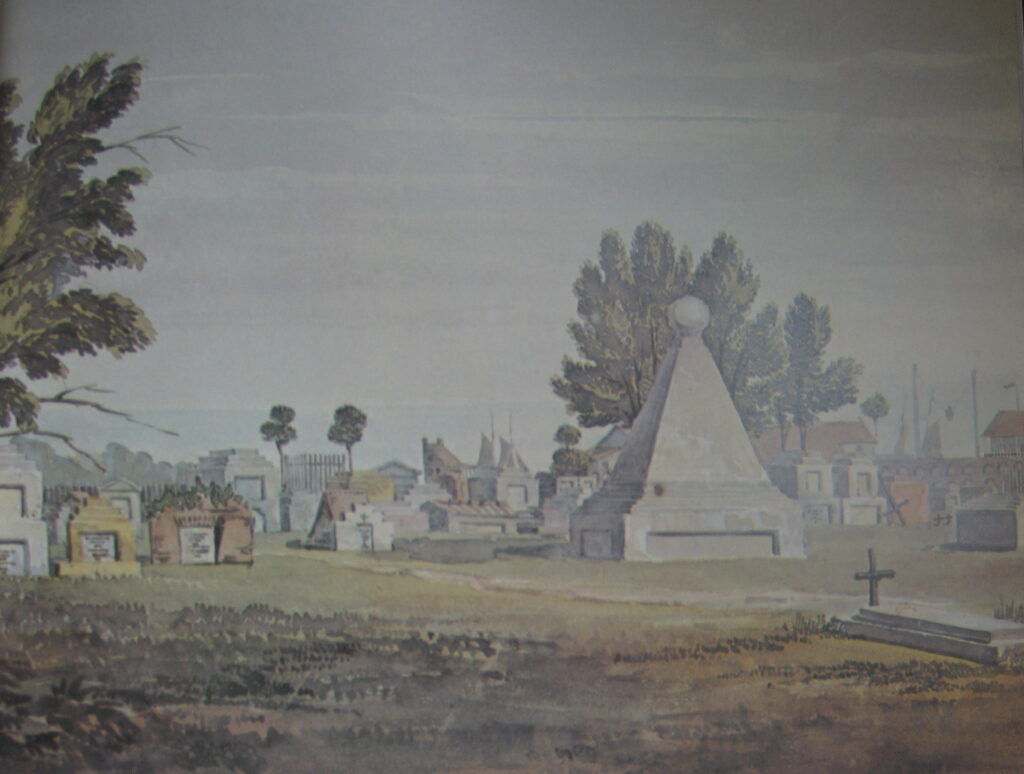
St. Louis Cemetery No. 1 is the oldest cemetery still standing in New Orleans, and people are still buried in its tombs. It opened in 1789, after a hard year for the city. In 1788, New Orleans suffered the first of its two great fires and an epidemic, and its burial ground on St. Peter Street was already full. Physicians worried about disease spreading, so the government ordered the old cemetery closed and a new one opened farther from where people lived.
The new ground lay just outside the fortified city, on low, swampy land too wet for anything else. A picket fence went up around it, and burials began right away. It was meant to be temporary until a Spanish royal decree of August 14, 1789, made it permanent. Louisiana was a Spanish colony at the time.
Why the Tombs Are Above Ground
The first burials here were probably in the ground, the way they had been on St. Peter Street. Save Our Cemeteries, a nonprofit that works to preserve the city’s historic cemeteries, says the earliest graves are thought to have been below ground or in low tombs. Experts believe the concrete and marble vaults went up on top of them later, to make room for more burials.
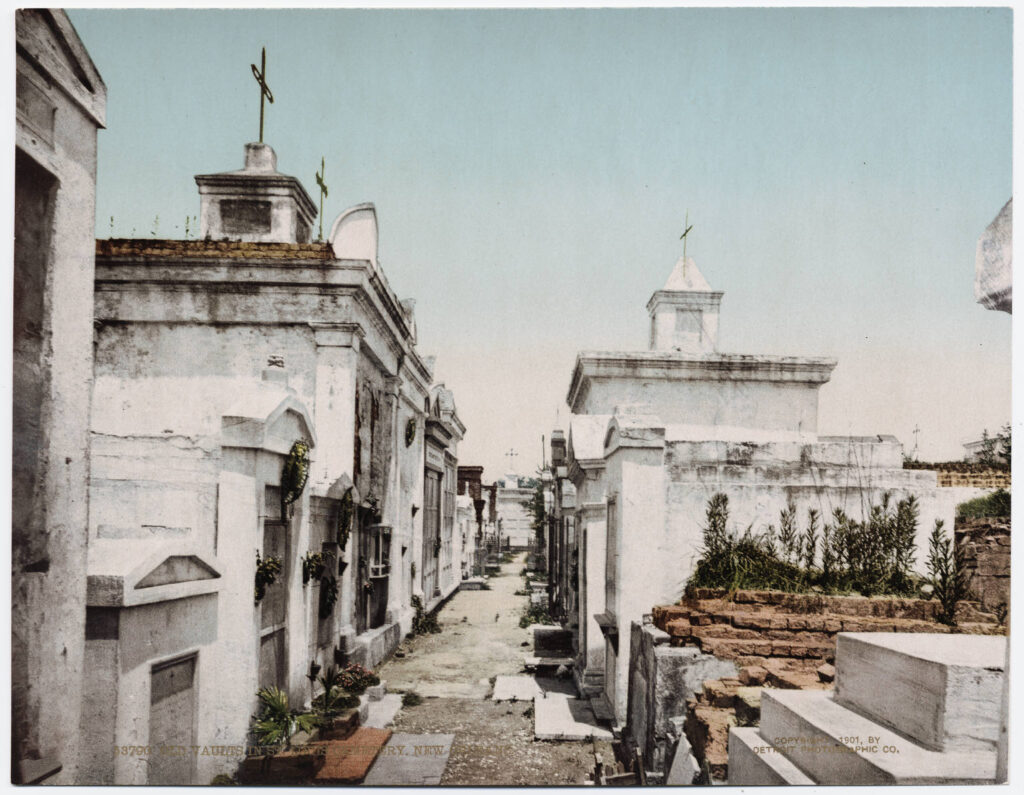
In 1803, a city ordinance ordered every burial above ground, to cope with the low land and the constant threat of flooding. It wasn’t strictly followed, but it set the style most familiar in New Orleans today: above-ground tombs. New Orleans Catholic Cemeteries, the Archdiocese of New Orleans office that runs the cemetery today, calls them a tradition inherited from France and Spain. It adds that they solved the problem of “a very high water table.”
Edward Henry Durell, a travel writer who visited New Orleans in the mid-1800s and wrote as Henry Didimus, described the alternative in his 1845 book, New Orleans As I Found It. Burial underground, he wrote, was only for “the stranger without friends or the poor without money.” Even then, the water in the soil “often forces the coffin and its contents out of its narrow and shallow cell.”
Family Tombs, Society Tombs, and Wall Vaults
Most of the tombs are simple rectangles, taller than they are wide, with flat, curved, or gable roofs. They were built of brick, then plastered and whitewashed, sometimes tinted anywhere from yellow to red. Each was meant for generations of one family. When a new burial was needed, the bones already inside were swept to the back of the tomb or into an ossuary to make room.
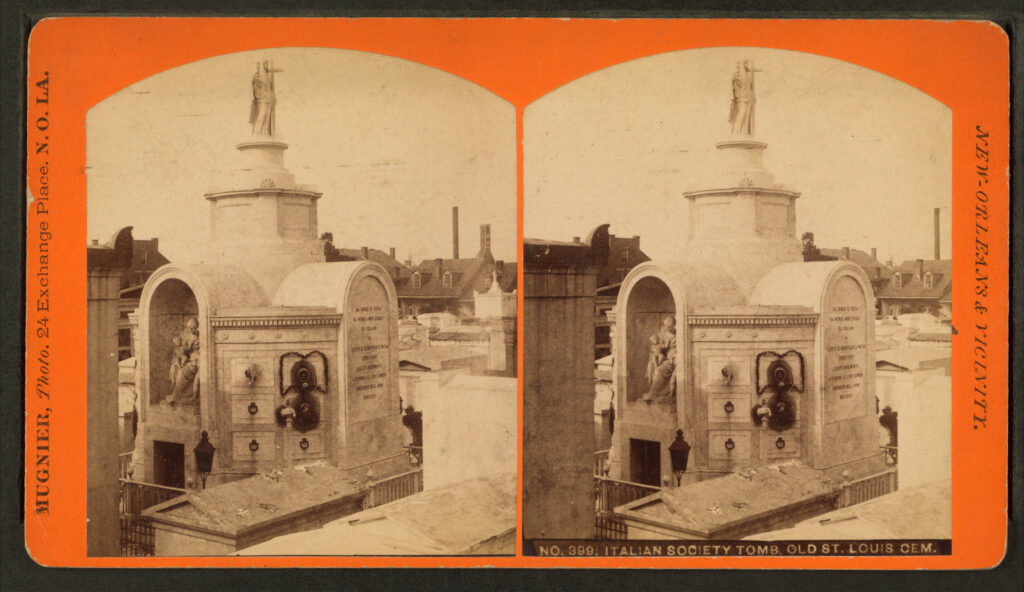
A few tombs rise more than one story and hold several burial vaults. These are society tombs, built by fraternal and benevolent societies to make sure their members had a decent burial.
The high brick walls around the cemetery are lined on the inside with wall vaults, a cheaper choice than a freestanding tomb. In New Orleans they’re called fours, or “oven vaults.” The city sold them to raise money. On All Saints’ Day, November 1, families in every New Orleans cemetery visit their ancestors’ tombs, freshen the whitewash, and bring flowers.
A Cemetery That Shrank
The cemetery was once bigger. Heavy use in its early years pushed it past its first boundary, right up to the ramparts of the fortified city. After the Louisiana Purchase in 1803 and the Haitian Revolution, the city’s population changed dramatically. Americans from the Northern states brought Protestantism with them, and the cemetery was enlarged again. A new parcel at the back became a Protestant burial ground, with a space beside it for the burials of African Americans and people of color. In 1805, the city gave the Protestant ground to Christ Church, a newly founded Episcopal congregation.
The architect Benjamin Henry Latrobe and his son Henry are buried in the ground at the back, in the part set aside for those who were not Roman Catholic. Latrobe had described the cemetery himself in 1819, as its 1975 nomination to the National Register of Historic Places tells it. He found Catholic and Protestant sections next to each other, each about 300 feet square. The Protestants were “relegated to the back,” and the graveyard for Black New Orleanians lay to the rear of theirs.
Then the city cut through the cemetery. In June 1832, the City Council set out to extend Conti, Treme, and Basin streets across its land. The church wardens and the city surveyor, Joseph Pilie, oversaw moving the burials in the way into a smaller footprint, and the main entrance gate dates from that project. When Treme Street was laid out, it cut through the Protestant section and separated it, and the burial ground for people of color, from the rest of the cemetery.
By 1838, most of the Protestant dead had been moved to the newer Girod Street Cemetery. In 1840, what was left of their section west of Treme Street was sold as building lots. Then the cemetery lost another strip. In 1847, the church wardens of St. Louis Cathedral gave up the land along St. Louis Street so the city could make improvements there. Between 1847 and 1852, the people buried in it were moved to new vaults on Basin and Conti streets or into family tombs. Only a small strip of the Protestant section is left, along Treme and Conti streets.
Who Is Buried Here
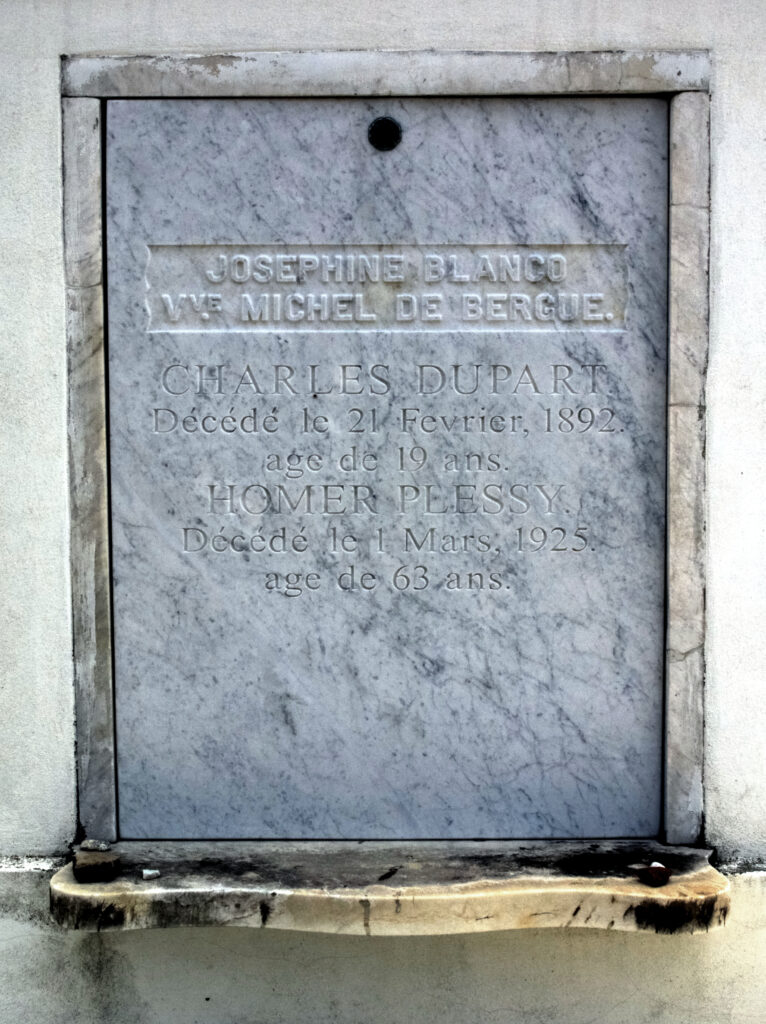
Homer Plessy, the Creole shoemaker whose challenge to racial segregation went to the U.S. Supreme Court, lies in the Debergue-Blanco family tomb. The court ruled against him in Plessy v. Ferguson, holding that segregation laws were constitutional.
Étienne de Boré, the sugar refiner who became the first mayor of New Orleans, is buried here, and so is the world chess champion Paul Morphy. Marie Laveau, remembered as the city’s Voodoo queen, lies in her family’s tomb.
In 2008, Louisiana added the cemetery to its African American Heritage Trail because of the large number of historically and culturally significant African Americans buried here. It had been on the National Register of Historic Places since 1975, listed as nationally significant for its art and architecture.
Tour Only Since 2015
Most of the tombs belong to families, and many of those families left the region or died off decades ago, leaving their tombs untended for generations. In 2014, the Times-Picayune, the city’s daily paper, reported that 75 percent of the nearly 1,000 tombs in St. Louis No. 1 were estimated to be orphaned. The other problem was vandalism. On December 17, 2013, tour guides and Save Our Cemeteries officials found that a vandal had covered Marie Laveau’s tomb in pink latex paint and painted the marble plaque on its face white.
In January 2015, the archdiocese, which owns the cemetery, announced that from March 1, only relatives of the dead, visiting scholars, and visitors with a tour guide registered with the archdiocese could enter. Sherri Peppo, director of New Orleans Catholic Cemeteries, said several tombs had been broken into and vandalized in the past year, and even security cameras had been stolen. Its spokeswoman added people “leaving trash in the cemetery, littering, setting up camp.” Guides had to register. They had to show insurance and a city license, and pay $40 for a one-time pass or $4,500 to $5,400 a year to give regular tours. The fees were meant to pay for staff during business hours and for security.
WWNO, New Orleans’ public radio station, reported that people had been taking selfies inside tombs, and that someone had even scattered human remains from one. “So the archdiocese, they had enough,” Amanda Walker of Save Our Cemeteries told the station. Peppo looked back on it for the Associated Press in 2018. “We were having so much vandalism in the cemetery,” she said. Panhandlers had also been posing as tour guides and “handing visitors markers to mark up the tombs.”
In early 2020, during the city’s COVID shutdowns, the archdiocese closed the cemetery to all tourists. When it reopened in late 2021, it let in only the immediate family of those buried here and a single tour company with a contract with the archdiocese. The Advocate, a New Orleans paper, reported the change from court documents in 2023.
Today, New Orleans Catholic Cemeteries says tours of St. Louis Cemetery No. 1 “are offered only by Cemetery Tours New Orleans.” Families of the people buried here show a family pass at the front gate. The cemetery’s outer brick walls were restored in 2015, for $500,000. The office’s Abandoned Tomb Initiative restores neglected tombs with no family contact on file, following National Park Service standards, and is paid for by tourism revenue and donors.
Hauntings & Lore
Legends of America, a history and folklore site, calls St. Louis Cemetery No. 1 the oldest cemetery you can visit in New Orleans and says it “is also said to be the most haunted.” Its most famous grave belongs to Marie Laveau, and two of its ghosts are still looking for graves of their own.
Marie Laveau’s Tomb
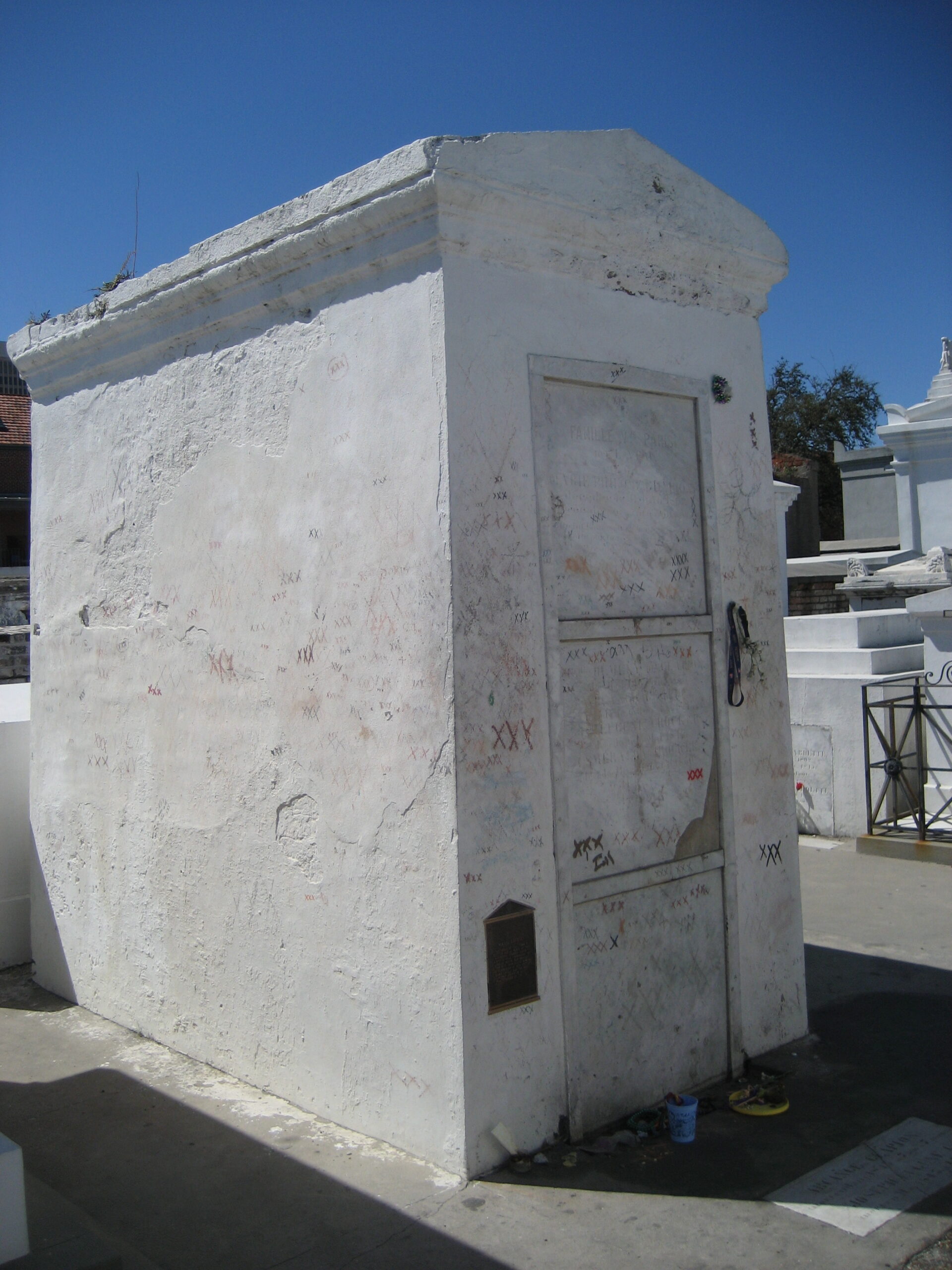
Almost as soon as Marie Laveau died in 1881, devotees began coming to her family’s tomb with offerings and petitions. Later visitors added a ritual of their own: draw an X on the tomb, knock, and make a wish. In his 1946 book Voodoo in New Orleans, the writer Robert Tallant described Voodoo followers who came to the tomb “to knock three times on the slab and ask a favor.” Over the years, the Xs did great damage to the tomb, and marking tombs was one of the reasons the archdiocese gave for closing the cemetery to visitors on their own in 2015. Her own page tells the tomb’s whole story.
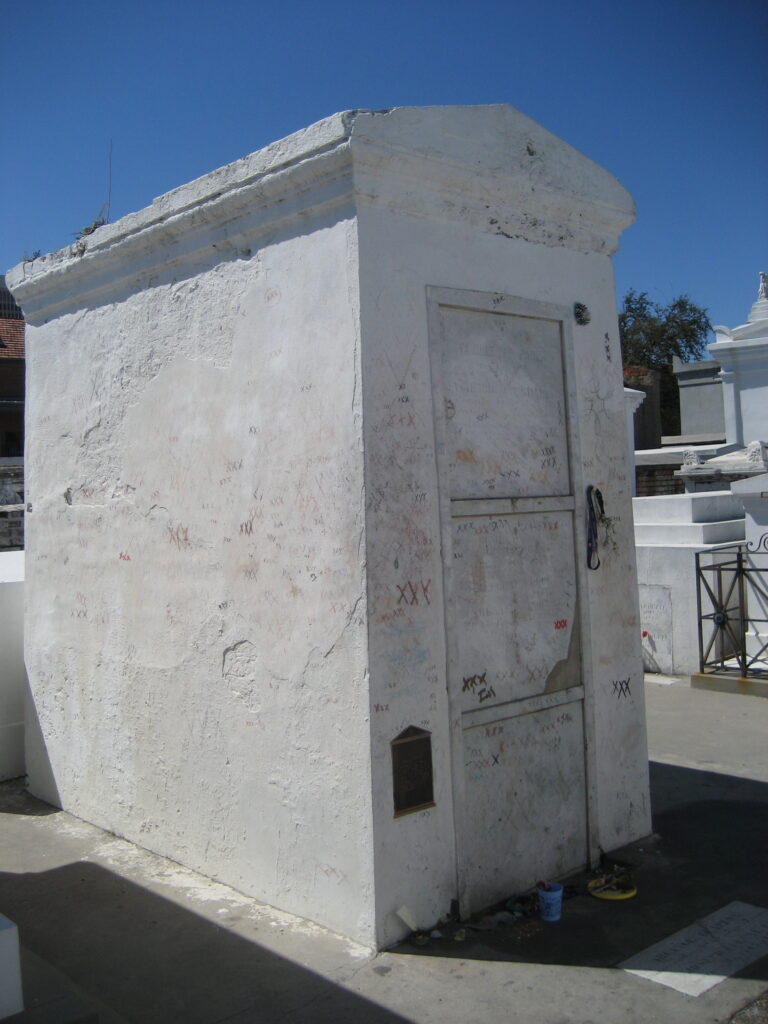
The writer Michael Kleen says Marie Laveau “is said to haunt Saint Louis Cemetery No. 1.” He passes on a warning from the legend, too: disrespecting her grave can lead to misfortune.
Henry Vignes, Looking for His Tomb
Kathy Alexander of Legends of America tells this one. Henry Vignes was a sailor in the 19th century who stayed at a boarding house whenever he was in New Orleans, and his family had a tomb in St. Louis Cemetery No. 1. Before his last voyage, he asked the boarding-house owner to keep his important papers safe, among them the papers for the family tomb. When he came back, he found she had sold it. He fell ill and died before he could set it right, and with no money, he was buried in an unmarked grave in the paupers’ section.
Alexander writes that he is often seen in the cemetery, tall, with blue eyes and a white shirt, asking visitors whether they know where the Vignes tomb is. In another version, he turns up at funerals to ask the mourners if there’s any room in the tomb for him. What he says most, she writes, is “I need to rest!”
Alphonse
In a 2019 piece for The Line-Up, a horror and true-crime site, Kristen Wheeler tells of a ghost called Alphonse who roams the paths “in search of a final resting place.” He’s known, she writes, to take visitors’ hands, pull them to a stop, smile widely, and ask them to bring him home. He gathers flowers from freshly tended graves and lays them on his own forgotten tomb. Wheeler writes that he is thought to have been murdered, and that anyone who goes near the Pinead family tomb is told to stay away.
Delphine LaLaurie’s Grave
Delphine LaLaurie, the woman the writer Carolyn Morrow Long calls the “Mistress of the Haunted House,” has a legend here, too. One version says a wild boar gored her to death in 1842, on a hunt near the resort village of Pau. Her body, the legend goes, was brought back to New Orleans to be buried in St. Louis Cemetery No. 1.
Long found a quieter ending in the records. Delphine died after a long illness at her home in Paris on December 7, 1849, and her remains were exhumed in 1851 to be sent to New Orleans. The archdiocese’s registers show that the tomb said to be hers belonged to her son, Paulin Blanque, and Long thinks she is probably in it. Nobody can say for certain. Because of poor record keeping, neither Delphine nor any of her immediate family appears in the list of burials, and the first burial recorded is a great-granddaughter who died in 1884.
Nicolas Cage’s Pyramid
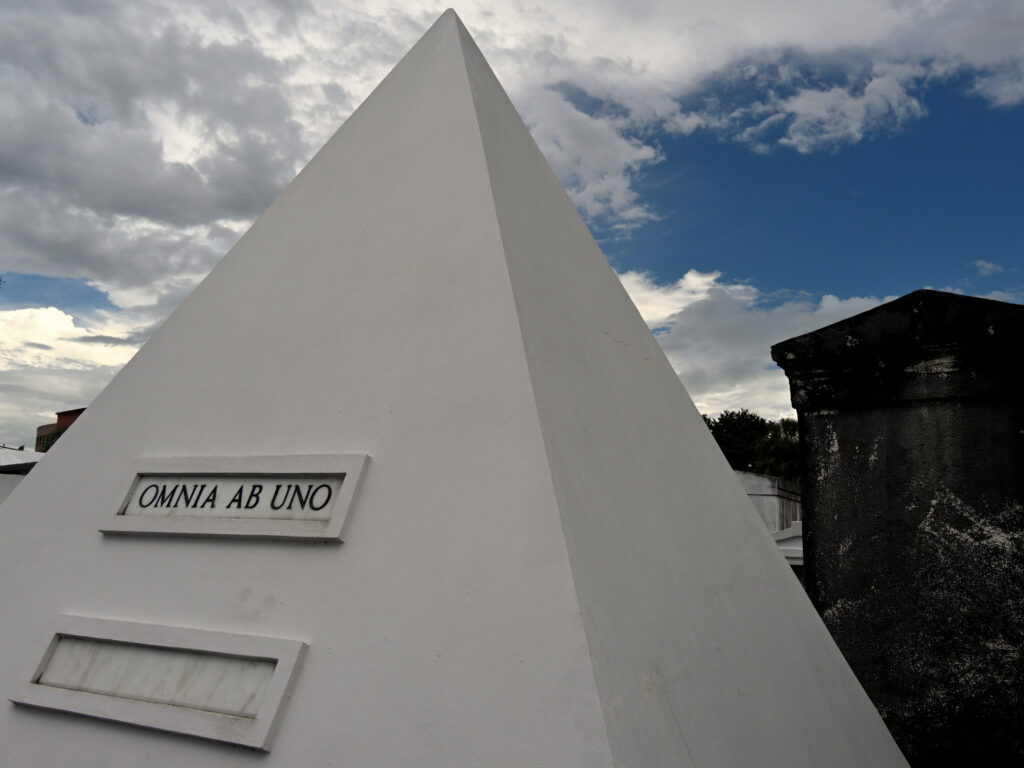
Not every tomb here is old. The actor Nicolas Cage bought one shaped like a pyramid, and the purchase made the papers in April 2010. He is, as an Associated Press photo caption put it, “alive and well.” Ripley’s, the oddities company, puts the white pyramid at nine feet tall and translates its Latin motto, “omnia ab uno,” as “Everything from One.” Ripley’s also says the tomb has drawn attention of its own, with women leaving red lipstick marks on its white surface.
Visit
Visiting St. Louis Cemetery No. 1
- Official visitor info: St. Louis Cemetery No. 1 — New Orleans Catholic Cemeteries
- How to visit: Only on a guided tour. New Orleans Catholic Cemeteries, which owns the cemetery, says tours of the cemetery are offered only by Cemetery Tours New Orleans, and its page above links to the booking. Families with loved ones buried here show a family pass at the front gate.
- Finding the story sites: Marie Laveau lies in the Laveau-Glapion family tomb. Homer Plessy is in the Debergue-Blanco family tomb, whose tablet is headed “Josephine Blanco, Vve Michel de Bergue.” What survives of the Protestant section is the strip along Treme and Conti streets. The main gate, on Basin Street, dates from the street work of 1832.
- Rules worth knowing: Don’t mark the tombs. The archdiocese named marked-up tombs among its reasons for the 2015 rule, and Amanda Walker of Save Our Cemeteries called the X ritual a myth that only damages a historic grave. The owner also bans bike and motorized tours, food, and alcohol, and allows only certified service animals.
- Worth knowing: Some accounts put Marie Laveau in a wall vault in St. Louis Cemetery No. 2, but archival records place her here, in No. 1.
Location
501 Basin St, New Orleans, LA 70112
Been here?
Tell us what happened.
Related People
-

Marie Delphine MacCarthy LaLaurie
Delphine LaLaurie’s biographer calls her the “Mistress of the Haunted House.” In April 1834, after a fire exposed the enslaved people she… read more
-
Marie Laveau
When Marie Laveau died in 1881, the New York Times called her the “Queen of the Voudous,” and New Orleans still knows… read more
Contributors

Sources (15)

Louisiana's online encyclopedia: Karen Kingsley's St. Louis Cemeteries No. 1, No. 2, and No. 3, and Carolyn Morrow Long's Mistress of the Haunted House

New Orleans Catholic Cemeteries
The Archdiocese of New Orleans' cemetery office, which owns the cemetery: its St. Louis Cemetery No. 1 page (history and visiting rules, read October 20, 2026) and its Abandoned Tomb Initiative page

National Register of Historic Places nomination: St. Louis Cemetery No. 1
National Park Service · prepared by Save Our Cemeteries, April 1975

The Ancestors: Marie Laveau's Tomb
New Orleans Historical

Solo tourists banned in New Orleans' oldest cemetery
Associated Press, in the Post Bulletin · Janet McConnaughey, January 31, 2015

Archdiocese Of New Orleans Restricts Access To Historic Cemetery
WWNO for NPR, via WKMS · Eve Troeh, November 2, 2015

Tomb of Marie Laveau, Voodoo queen of New Orleans, refurbished in time for Halloween
The Times-Picayune · Richard A. Webster, October 30, 2014

The Times-Picayune of December 31, 2013 and January 27, 2015; the St. Louis Post-Dispatch of April 18, 2010; the Associated Press, July 31, 2018; The New Orleans Advocate, January 13, 2023

Robert Tallant, Voodoo in New Orleans (1946)

Haunted Cities of the Dead in New Orleans, Louisiana
Legends of America · Kathy Alexander

7 Infamous Spirits Haunting St. Louis Cemetery No. 1
The Line-Up · Kristen Wheeler, May 14, 2019

Voodoo, Villains, and Visions: The Unique Hauntings of New Orleans
Michael Kleen, 2025

History, Hollywood and voodoo all in a New Orleans cemetery
Associated Press, in the Tampa Bay Times · photo caption by Beth J. Harpaz

The Nicolas Cage Pyramid Tomb in New Orleans' Oldest Cemetery
Ripley's Believe It or Not!

The episode lists for Haunted History and Most Terrifying Places in America (Investigations)